· ReadyStack
Worked example
Real numbers from this tool, line by line.
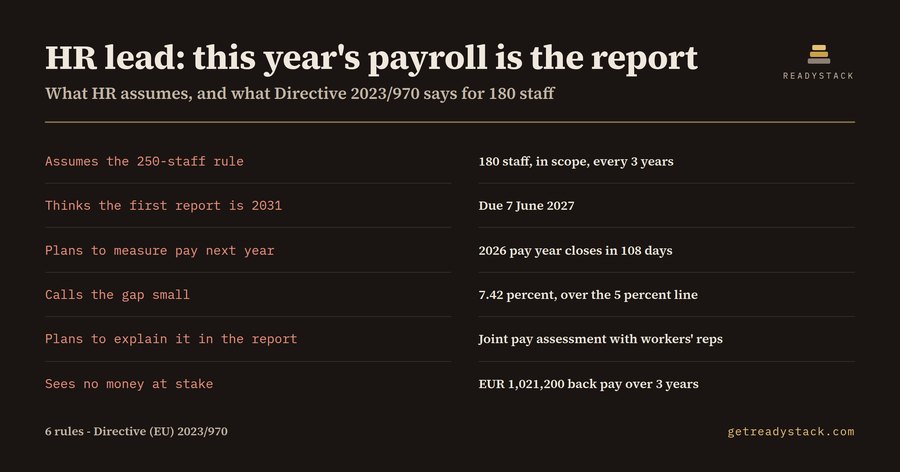
EUR 1,021,200 is the three-year back pay exposure sitting in one 180-person employer's payroll file right now: one category of workers, men on an average of EUR 62,000, women on EUR 57,400. The HR lead running that payroll in Dublin, Warsaw or Rotterdam has not filed a gender pay report in their life, and is fairly sure they do not have to.
That belief has a number attached to it: 250. Ask almost any HR manager at a mid-sized European employer when gender pay reporting starts, and you get "250 staff". Ask a chatbot and you get the same answer, because 250 is the line that appears most often in the text it was trained on.
It is only one of four bands.
Directive (EU) 2023/970, the EU Pay Transparency Directive, had to be in national law by 7 June 2026. It is now live, and it sorts employers like this:
- 250 workers and over: report every year, first report by 7 June 2027.
- 150 to 249 workers: report every three years, first report also by 7 June 2027.
- 100 to 149 workers: report every three years, first report 7 June 2031.
- Under 100 workers: outside the reporting duty.
The band that gets hurt is the second one. A 180-person employer reports on exactly the same date as a 2,000-person employer, and almost nobody in that band has a pay data process for it.
The second number that goes missing is the pay year. The report due 7 June 2027 is built from calendar year 2026 payroll data. On 14 September 2026, that year has 108 days left to run. Whatever the gap is on 31 December 2026 is the gap that gets reported.
The third number is the one that turns a reporting duty into money. Where a gap above 5 percent shows up in a category of workers, is not justified on objective, gender-neutral grounds, and is not corrected within six months, the employer must run a joint pay assessment with workers' representatives. Article 21 of the Directive sets limitation periods of at least three years, so the arrears conversation is not about one payroll cycle.
Run the default numbers and the arithmetic is simple:
gap = (62000 - 57400) / 62000 = 7.42 percent excess = 62000 - 57400 = EUR 4,600 per woman per year 3 years x 74 women = EUR 1,021,200
That is why we built EU Pay Transparency 2026 Check as a browser extension rather than a spreadsheet. Six numbers go in - workers employed, average pay for men and for women in one category, how many women are in it, today's date, and whether you have a written objective justification. Six answers come out: the gap in percent, your reporting duty, your first report date, the days left in the pay year being measured, whether a joint pay assessment is triggered, and the three-year back pay exposure in EUR.
Change one input and the answer genuinely changes. At 300 staff the same tool returns an annual duty and a 10 percent gap on EUR 71,000 against EUR 63,900. At 120 staff it returns 7 June 2031 and 1569 days - the honest answer that you have time.
The whole calculation is free: in the extension popup, on the free web page, with no key, no watermark and no use counter. Nothing you type leaves the browser.
The $60 full version sits on a different axis, not a crippled one. It writes the worked answer out as a .csv row you keep in the pay file - the record of what you calculated and when - and sets the 30, 14 and 1 day reminders before your report date. Eurofound (2020) costed one gender pay report at about EUR 844 per company in Germany; a consultancy pay-equity project is quoted per engagement.
The same zip installs on Chrome, Edge and Firefox. The 2026 pay year closes in 108 days.
Questions people ask
What does this extension actually do?
It reads six rules of EU Directive 2023/970 against your own numbers. You type headcount, average pay for men and women in one category of workers, and how many women are in it. It returns your reporting duty, your first report date, the days left in the pay year being measured, whether the 5 percent joint pay assessment line is crossed, and the three-year back pay exposure in EUR.
Who is it for?
HR and payroll leads at EU employers between 100 and 300 workers, the band that has never filed a gender pay report and is not covered by an existing national one. Works pay leads at a Dutch, Irish, Polish or German company reading a job ad page or a payroll export in Chrome, Edge or Firefox.
Why will a free chatbot not do this?
Ask a chatbot and you will usually get the 250 worker rule, because that is the line it saw most often in training text. The 150 to 249 band reports on the same 7 June 2027 date, and the 100 to 149 band waits until 7 June 2031. A chatbot also cannot count the days left in the pay year that your first report will be built from.
What is free and what costs money?
Every number is free, in the popup and on the web page, with no key, no watermark and no use limit. The $60 licence key adds two things on a different axis: the .csv row you keep in the pay file as the record of what you calculated and when, and the 30, 14 and 1 day reminders before your report date.
What would this cost if a person did it?
Eurofound (2020) costed one gender pay report at about EUR 844 per company in Germany; a consultancy pay-equity project is quoted per engagement. The key here is $60 once, one licence key per person or team seat,. The calculation itself stays free forever.
Ask about this tool
One question, answered by the person who built it. Your email only if you want the answer sent.