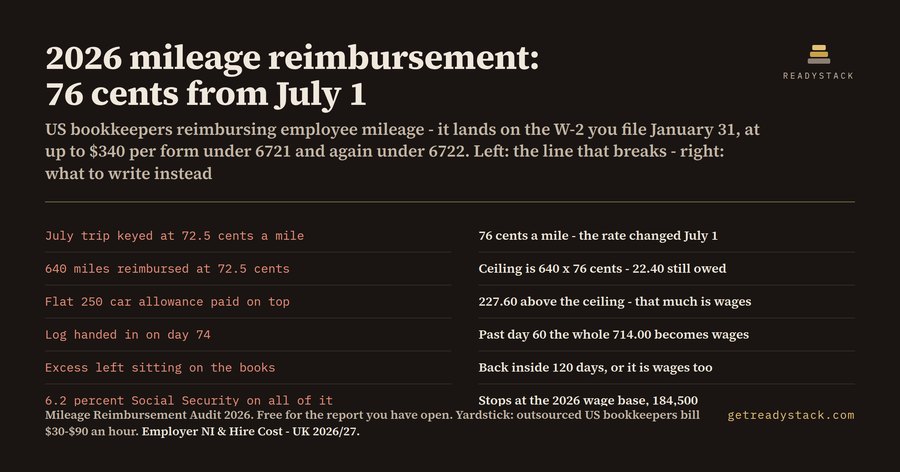
The 2026 business mileage rate did not hold one value all year: 72.5 cents through June 30, 76 cents from July 1 (Announcement 2026-11). Most expense templates still hold one number.
| IRS rate for this period | — | cents/mile |
|---|---|---|
| Your rate against the IRS rate | — | cents/mile |
| Short of the IRS rate on these miles | — | $ |
| Tax-free ceiling | — | $ |
| Total you paid | — | $ |
| Above the ceiling | — | $ |
| Goes on the W-2 as wages | — | $ |
| Employer payroll tax on that | — | $ |
| Ruling | — |
Free for the file open in your editor - no key, no limit. The workspace sweep and the report ask for a key.
Microsoft Edge Add-onsFirefox Add-onsdownload every check as a .csv audit trail you keep, one row per employee per month, carrying the inputs, the rate applied and the ruling
One payment, one licence key for this tool. The key is shown right after payment.
Outsourced US bookkeepers bill $30-$90 an hour in 2026 to re-check a year of mileage reports, and an incorrect Form W-2 runs up to $340 per form under IRC 6721 and again under 6722.
Buy the full version — $60I have a keyNeed more than this one? ReadyStack Pass opens all 593 files and 515 full versions — $29/month or $199/year. See the Pass →
· ReadyStack
Real numbers from this tool, line by line.
$227.60 of a $714.00 mileage report becomes W-2 wages, and the US bookkeeper who keyed it did nothing unusual: they paid 640 business miles at 72.5 cents and added the $250 monthly car allowance, exactly as the template has said all year.
The template is wrong from July 1.
The IRS set the 2026 business standard mileage rate at 72.5 cents a mile in Notice 2026-10. Then, on the back of a roughly 38 percent rise in gasoline prices between January and mid-July, Announcement 2026-11 raised it to 76 cents a mile effective July 1, 2026. One calendar year, two rates. Almost nothing that a bookkeeper touches knows this. Expense templates hold one number. Spreadsheets hold one number. Ask a chatbot what the 2026 mileage rate is and it will confidently say 72.5 cents, because that is the number the year opened with and the number most of its sources were written against.
Getting the rate wrong is only the first half. The second half is that a mileage reimbursement is not automatically tax-free money. It is tax-free only while the arrangement stays an accountable plan under Treas. Reg. 1.62-2, and that regulation has two hard clocks:
Miss the first clock and it is not just the excess that becomes wages. The entire payment becomes wages.
Here is the arithmetic on that ordinary report, run for a trip taken in September 2026:
Business miles                       640
Rate reimbursed                 72.5 c/mile
Flat car allowance                $250.00

IRS rate for Jul 1 - Dec 31, 2026   76.0 c/mile   <- Announcement 2026-11
Tax-free ceiling  640 x 0.76      = $486.40
Total actually paid  640 x 0.725 + 250
                                  = $714.00
Above the ceiling                 = $227.60   -> W-2 wages, not returned in 120 days
Employer payroll tax  7.65%       =  $17.41
Short of the IRS rate on the miles=  $22.40   -> still owed to the employee
Two errors in opposite directions, on one report, in one month. The $250 allowance was never substantiated by miles, so it is excess and it lands on the W-2. And because the miles themselves were paid 3.5 cents under the correct rate, the employee is simultaneously owed $22.40 if the company policy is "we pay the IRS rate."
Now change one field. Say the employee handed the log in 74 days after the trip instead of 21 — a July trip reconciled in late September, which is exactly what a lot of firms are doing right now. The 60-day window is gone, and the ruling changes from "$227.60 is wages" to "the whole $896.80 is wages." Nothing about the receipts changed. Only the calendar did.
The deadline on all of this is January 31, 2027, when Form W-2 is due. Anything you did not catch by then is not a spreadsheet edit any more, it is a Form W-2c, and an incorrect information return carries up to $340 per form under IRC section 6721 and up to $340 again under section 6722 for the copy furnished to the employee.
So we built the check as a browser extension, because that is where the work already happens — in QuickBooks Online, in Expensify, in Ramp, in a Google Sheet. Click the icon, key the seven fields, get the ruling. It picks the rate from the trip date instead of asking you to remember which half of 2026 you are in. It runs the 60-day and 120-day tests. It stops Social Security at the 2026 wage base of $184,500 rather than charging 6.2 percent on wages that are past it, which is why a sales lead at $184,450 year-to-date shows $4.14 of employer tax on $71.75 of excess and not $5.49.
The calculation is free. All of it, in the popup and on the web page, with no key, no usage cap and no watermark on the answer, because a half-answer is worth nothing to someone reconciling forty reports. The $60 full version does one different thing: it writes each check to a .csv audit trail you keep, one row per employee per month, carrying the miles, the rate that was applied and the ruling that followed from it. That is the file your auditor asks for and the file nobody has, because it was never anywhere except in the bookkeeper's head at the moment they keyed the report.
The rate will move again on January 1, 2027. The 60 and 120 day clocks will not.
You enter the miles, the rate you paid, any flat allowance and how long the employee took to hand in the log. It returns the correct 2026 IRS rate for that half of the year, the tax-free ceiling, the amount above it, the dollars that must go on the Form W-2 as wages, and the employer payroll tax on those dollars.
US bookkeepers, office managers and payroll administrators who reimburse employee mileage in QuickBooks Online, Expensify, Ramp or a spreadsheet, and the small-firm accountants who clean those reports up at year end. It assumes you are the person keying the expense report, not a tax lawyer.
Both hold one rate for 2026. The IRS set 72.5 cents in Notice 2026-10 and then raised it to 76 cents from July 1 in Announcement 2026-11, so a single-rate tool prices half the year wrong. Neither one applies the 60-day and 120-day accountable-plan tests that decide whether the money is wages.
The entire calculation is free, in the extension popup and on the web page, with no key, no usage cap and no watermark on the answer. The $60 full version adds one thing: downloading each check as a .csv audit trail you keep, one row per employee per month, with the rate and the ruling recorded.
Outsourced US bookkeepers bill $30 to $90 an hour in 2026, and re-pricing a year of mileage against two different rates is an hour or more per employee. An incorrect Form W-2 carries up to $340 per form under IRC section 6721 and up to $340 again under section 6722.
One question, answered by the person who built it. Your email only if you want the answer sent.
Paste this code into your page. It runs in your visitor’s browser and stays up to date. Nothing your visitors type is stored.
For businesses: your name and logo instead of ours, and each visitor’s result + e-mail in your inbox (only when they tick consent) — Pro from $19/month. See Pro →