· ReadyStack
Worked example
Real numbers from this tool, line by line.
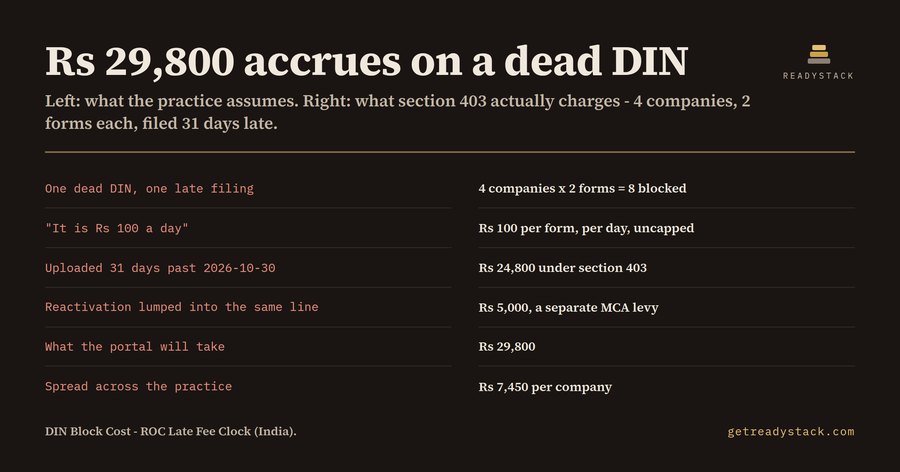
Rs 29,800 is what one deactivated DIN cost a Bengaluru company secretary last season, and she had done nothing wrong except trust a calculator that only knew how to price one form.
Here is the arithmetic she ran. One director. One missed KYC. One late AOC-4. She opened a free ROC late fee tool, typed a due date of 2026-10-30 and an upload date of 2026-11-30, and it told her Rs 3,100. Thirty-one days at Rs 100 a day. She budgeted for that.
What it did not ask her was how many companies that director signs for.
Section 403 of the Companies Act 2013 charges Rs 100 per day per late form, running from the due date to the day the form is actually uploaded, with no upper cap anywhere in it. The fee attaches to the form, not to the director and not to the practice. So when a DIN goes inactive, the meter does not start once. It starts at every company on that person's board, on every form that needs their signature, all at the same instant.
That director sat on four boards. Each of those four companies owed an AOC-4 and an MGT-7. Eight forms, not one. Thirty-one days late: Rs 24,800 under section 403, plus Rs 5,000 to reactivate the DIN by filing the KYC. Rs 29,800. Rs 7,450 per company, which is the number she actually had to explain to four different sets of promoters.
The spread on this is brutal, and that is the point. Catch the same problem in the same week, at one company: the tool returns Rs 6,400, of which Rs 5,000 is just the reactivation levy. Find it a year later, with an adjudication notice already served under section 137(3), and the same seven inputs return Rs 6,69,000 — Rs 2,92,000 of automatic section 403 fee, and Rs 3,72,000 of adjudicated penalty at Rs 10,000 plus Rs 100 per day, capped at Rs 2,00,000 for each company and Rs 50,000 for each officer in default.
Six thousand four hundred, or six lakh sixty-nine thousand, from the same dead DIN. The only variables are how many boards and how many days.
This is also a bad year to be asking a chatbot. The amendment effective 31 March 2026 moved director KYC from an annual filing to a triennial cycle, and published sources still disagree on when the first cycle actually falls due. Ask a general-purpose AI and you will get last year's rule stated with total confidence. So this extension hardcodes no deadline at all. Every date in it is a date you type, and the reactivation fee is a field too, defaulting to the widely cited Rs 5,000 so you can overwrite it when the portal quotes you otherwise.
What it does is the multiplication nobody else does: companies, times forms per company, times days, times Rs 100 — with the reactivation levy kept on its own line and the adjudicated penalty kept behind a checkbox, because one is automatic at upload and the other only exists once a notice lands. Blending those two is how practices end up quoting a promoter a number that is either embarrassing or wrong.
The calculation is free. All of it, in the popup and on the web page, no key, no watermark, no usage cap, no locked result. What the licence key adds sits on a different axis: a CSV of the per-company breakdown to file, and reminders 30, 14 and 1 day before each due date you enter, so next season the meter never starts.
Indian practitioners quote Rs 500 to Rs 2,000 per director just to file the KYC that reactivates a DIN. The fee this prices has no ceiling at all.
Questions people ask
What does this actually calculate?
It takes one deactivated DIN and multiplies it across every company where that director signs, then charges section 403 of the Companies Act 2013 at Rs 100 per form per day from your due date to the day you can actually upload, and adds the MCA reactivation fee per DIN.
Who is it for?
Company secretaries and CA practices in India carrying the ROC work for several private limited companies that share directors. When one of those directors loses a DIN, the annual filings at every one of those companies stop at once, and one person has to price that.
Why will a free calculator not do this?
Free ROC late fee calculators on Indian practice websites price one form for one company. None of them multiply a single dead DIN across every company that person signs for, and none separate the automatic section 403 levy from the adjudicated penalty under section 92(5) or 137(3).
What is free and what needs a key?
Every calculation is free, in the popup and on the web page, with no key, no watermark and no usage limit. The licence key adds two things on a different axis: a CSV export of the per-company breakdown to keep, and Chrome reminders 30, 14 and 1 day before your due dates.
What would a person charge to work this out?
Indian practitioners quote roughly Rs 500 to Rs 2,000 per director simply to file the DIR-3 KYC that reactivates a DIN, before anyone prices the blocked filings. The section 403 fee itself is Rs 100 per form per day and carries no upper cap at all.
Ask about this tool
One question, answered by the person who built it. Your email only if you want the answer sent.