· ReadyStack
Worked example
Real numbers from this tool, line by line.
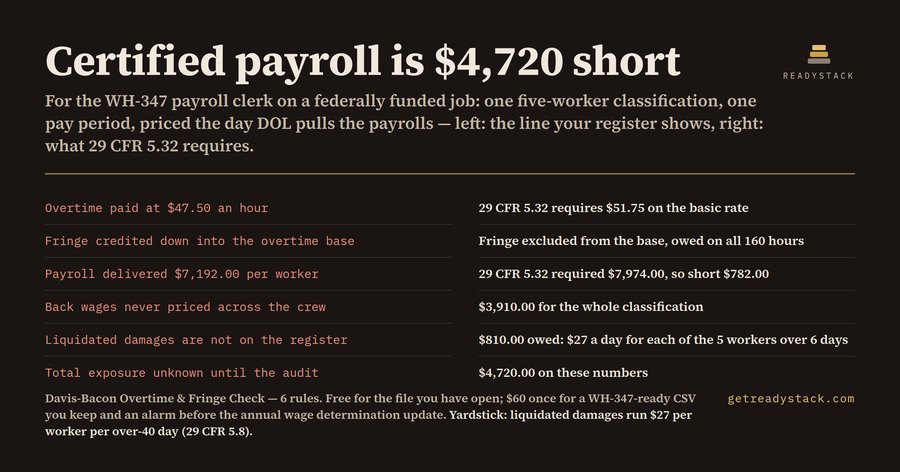
$4,720 is owed on this one pay period - US payroll clerks signing WH-347 certified payroll on federally funded construction, one five-worker classification, one 160-hour period.
| Line | What the register shows | What 29 CFR 5.32 requires |
|---|---|---|
| Overtime cash rate | $47.50 an hour | $51.75 an hour |
| Fringe paid on | 136 straight-time hours | all 160 hours worked |
| Pay per worker, this period | $7,192 | $7,974 |
| Shortfall per worker | - | $782 |
| Back wages, five-worker crew | - | $3,910 |
| CWHSSA liquidated damages | nothing on the register | $810 |
| Total exposure | - | $4,720 |
Nobody stole anything. The clerk built the overtime base the way every free calculator and every chatbot builds it, and the register balanced.
Here is the arithmetic. The wage determination on that job carries a basic rate of $34.50 an hour and a fringe rate of $12.75. The contractor paid $34.50 in cash and $8.50 an hour into a bona fide plan. For the 24 hours over 40, the clerk credited the fringe contribution against the cash rate, got a base of $26.00, added the half-time premium on top of that, and paid overtime at $47.50 an hour.
29 CFR 5.32 and 29 CFR 778.6 say the opposite. Fringe benefit payments are excluded from the rate used to compute the overtime premium under the Davis-Bacon Act, CWHSSA and the Fair Labor Standards Act. The premium rides on the basic hourly rate alone, which here is $34.50. The required overtime cash rate is $51.75. The gap is $4.25 an hour, and it is invisible on the register because both numbers look like overtime.
The second half of the rule is the one people forget: the fringe rate is owed on every hour worked, not on the first 40. Pay fringe on 136 straight-time hours instead of all 160 and you are short again, in the other direction. Add both errors and one worker is $782 short for the period; the five laborers and mechanics in that classification make $3,910.
Then comes the part that is not a wage at all. Under 40 U.S.C. 3702(b) and 29 CFR 5.8, a contractor owes liquidated damages of $27 for each calendar day on which a laborer or mechanic was permitted to work over 40 hours in the workweek without the required overtime pay. It does not scale with how small the underpayment was. Six over-40 days across five workers is 30 days, and 30 times $27 is $810. The Labor Department's annual civil-penalty inflation adjustment for 2026, published in the Federal Register on 2026-05-27, left that amount unchanged from 2025.
Change one input and the answer moves. A twelve-person site crew paid $30.00 cash against a $28.90 basic rate and a $9.60 fringe, with no overtime premium at all on 32 over-40 hours, is $1,976 short per worker: $23,712 in back wages and $2,592 in liquidated damages, $26,304 in total. A nine-person mechanical crew that built the overtime base correctly can still be $9,273.60 short on the fringe obligation, with zero liquidated damages.
Timing matters. The 2023 update to the Davis-Bacon regulations, effective 2023-10-23, incorporates the contract clauses and the wage determination by operation of law and updates non-collectively-bargained rates periodically. A rate can move under a job you already priced. The same rule requires payrolls and basic records be kept at least three years after all work on the prime contract is completed, and 29 CFR 5.12 puts three years of debarment on the table.
Davis-Bacon Overtime & Fringe Check runs the whole calculation in the browser and returns 9 numbers on every run: required pay, what the payroll delivered, the required overtime rate, the overtime rate you paid, the per-worker shortfall, the crew back wages, the liquidated damages, the total exposure, and a plain-language verdict. No key, no cap, nothing leaves the page. The $60 licence key adds the next job, not the answer: a WH-347-ready CSV you keep for the three-year retention period, and an alarm before the annual wage determination update.
15 seconds — what it actually does
Full walk-through
Questions people ask
What does this actually calculate?
It rebuilds one worker's pay period the way 29 CFR 5.32 requires: the basic rate for every hour, a half-time premium computed on the basic rate with fringe excluded, and the fringe rate on overtime hours too. It then subtracts what your payroll delivered and prices the gap across the classification, adding $27 per worker per over-40 day.
Who is it for?
Payroll clerks and owners at small electrical, mechanical, concrete and site-work subcontractors who sign WH-347 certified payroll on federally funded construction. It is built for the person who types the hours, not for a compliance department, and it assumes you already have the wage determination open in another tab.
Why not just ask a chatbot or use a free overtime calculator?
A generic overtime calculator multiplies the rate actually paid by 1.5, which is the wrong base under Davis-Bacon. Chatbots routinely fold the fringe rate into the overtime base or drop fringe from overtime hours, and none of them add the CWHSSA liquidated-damages day count. The error hides inside a number that looks plausible.
What is free and what needs the key?
Every calculation is free with no key, no watermark and no usage cap: required pay, the correct overtime rate, the shortfall, crew back wages, liquidated damages and total exposure. The $60 key changes the axis, not the answer. It adds CSV export you keep and an alarm before the annual wage determination update.
What would this cost me if I got it wrong?
Back wages for every affected hour, plus liquidated damages fixed by rule at $27 per worker per over-40 calendar day under 29 CFR 5.8, an amount the Labor Department left unchanged for 2026. Repeat disregard can also bring three years of debarment from federal contracts under 29 CFR 5.12.
Ask about this tool
One question, answered by the person who built it. Your email only if you want the answer sent.