· ReadyStack
Worked example
Real numbers from this tool, line by line.
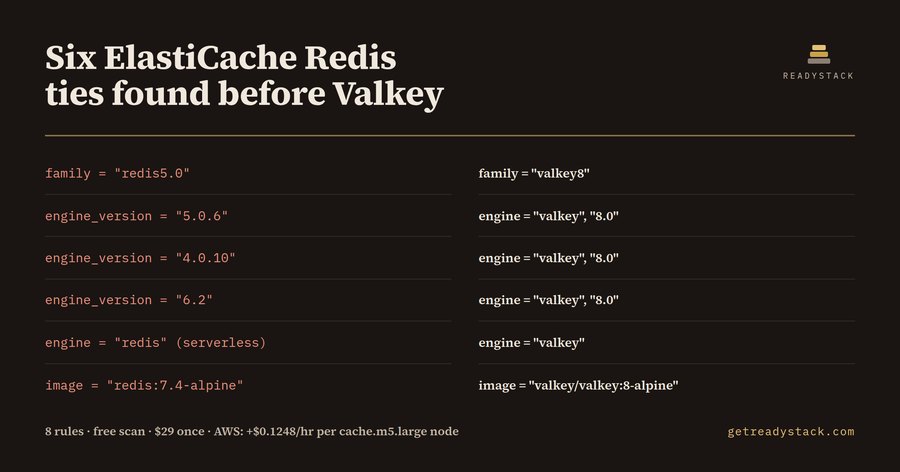
Six Redis ties turned up in a 44-line main.tf that a platform engineer running AWS ElastiCache checked before moving to Valkey: three errors and three warnings, on six different lines, and two of the caches were already paying an 80% Extended Support premium.
What AWS changed, and when
AWS ended standard support for ElastiCache Redis OSS versions 4 and 5 on January 31, 2026. Since February 1, 2026, every cache still on those versions is enrolled in Extended Support automatically and billed for it: an 80% premium on the on-demand node price in years one and two, and 160% from February 1, 2028. After January 31, 2029, AWS upgrades the remaining caches to Valkey itself. Redis OSS 6 follows one year later: standard support ends January 31, 2027, and the charge starts February 1, 2027.
AWS's own example puts a number on it. A cache.m5.large node on Redis OSS 5 in US East (Ohio) costs $0.156 an hour on demand; Extended Support adds $0.1248 an hour. Reserved-node discounts do not apply to that surcharge. At the same time AWS prices node-based ElastiCache for Valkey 20% lower, and ElastiCache Serverless for Valkey 33% lower, than the other engines.
The six lines
| Line | Redis line | Valkey fix |
|---|---|---|
| 4 | family = "redis5.0" | family = "valkey8" |
| 11 | engine_version = "5.0.6" | engine = "valkey", engine_version = "8.0" |
| 20 | engine_version = "4.0.10" | engine = "valkey", engine_version = "8.0" |
| 28 | engine_version = "6.2" | engine = "valkey", engine_version = "8.0" |
| 35 | engine = "redis" (serverless) | engine = "valkey" |
| 42 | image = "redis:7.4-alpine" | image = "valkey/valkey:8-alpine" |
The three errors are the two caches on Redis OSS 4.0.10 and 5.0.6, which are billed today, and the redis5.0 parameter group. That one is easy to miss: a parameter group family belongs to one engine version, so a cache cannot switch engines while it still points at redis5.0. The three warnings are the Redis OSS 6.2 cache (an error from February 1, 2027), the serverless cache on the redis engine, and an ECS sidecar pulling redis:7.4-alpine. Redis 7.4 and later ship under RSALv2 and SSPLv1 (Redis 8 adds AGPLv3) instead of the BSD-3 licence of Redis 7.2; Valkey, the Linux Foundation fork of Redis 7.2.4, stays BSD-3.
Why the console is not enough
The ElastiCache console lists what is running, not the Terraform line that pins it. A chatbot will rewrite the file you paste, but it does not know the Extended Support dates and usually leaves the parameter group alone.
Checking every line at once
Valkey Migration Check reads Terraform, CloudFormation, compose, Kubernetes YAML and Dockerfiles against 8 rules: Redis OSS 4 and 5 engine versions, Redis OSS 6 engine versions, redis4.0 and redis5.0 parameter groups, redis6.x and redis7 parameter groups, serverless caches on redis, node caches on redis 7, redis:7.4+ images and redis/redis-stack images. Each finding names the line, the Valkey replacement and the source page. The fixed main.tf returns 0 findings.
The as-of date changes the answer. Set it to February 1, 2027 and the Redis OSS 6 warning becomes an error; set it to February 1, 2028 and the Redis OSS 4 and 5 findings name the 160% premium.
Start with the caches already billed, then move Redis OSS 6 before February 1, 2027.
The single-file check is free in VS Code and on the web page, with every rule and every fix. The paid version scans every repo in a workspace and exports a dated Markdown migration plan per repo.
15 seconds — what it actually does
Questions people ask
What does Valkey Migration Check do?
Valkey Migration Check reads Terraform, CloudFormation, compose, Kubernetes and Dockerfiles and flags each line that ties a project to Redis: ElastiCache Redis OSS 4, 5 and 6 engine versions, redis parameter group families, serverless and node caches on the redis engine, and redis:7.4 or later images. Each finding shows the Valkey replacement line and the AWS or Redis source.
Who is Valkey Migration Check for?
It is for platform engineers and DevOps leads who run Redis on AWS ElastiCache through Terraform or CloudFormation. ElastiCache Redis OSS 4 and 5 caches have been billed an 80% Extended Support premium since February 1, 2026, and Redis OSS 6 caches follow on February 1, 2027. It also suits teams leaving Redis 7.4 images over the licence change.
Why not ask a chatbot or read the AWS console?
The ElastiCache console lists running caches, not the Terraform line that pins each version, so the next apply can recreate a Redis OSS 5 cache. A chatbot rewrites the file you paste but does not know the Extended Support dates, and it often keeps the redis5.0 parameter group, which blocks the engine switch.
What is free and what does the paid version add?
The free version runs all 8 rules on the open file in VS Code and on the web page, with the Valkey fix on every finding and no cap. The paid version, $29 once with one licence key per person or team seat, scans every repo in the workspace and exports a dated Markdown migration plan per repo.
What does staying on Redis OSS 5 cost compared with this check?
In AWS's own example a cache.m5.large node on Redis OSS 5 in US East (Ohio) costs $0.156 an hour on demand, and Extended Support adds $0.1248 an hour, an 80% premium, in years one and two. Node-based ElastiCache for Valkey is priced 20% lower. The single-file check is free; the workspace plan is $29 once.
Ask about this tool
One question, answered by the person who built it. Your email only if you want the answer sent.