SaaS UI Kit — AI Act Article 50 chatbot notices & AI labels

For product designers of SaaS products with an AI assistant, AI writing or AI images that sell into the EU. Art. 50 of the EU AI Act applies since 2 August 2026.

Your product's AI features
Fine cap for breaching Art. 50 (Art. 99(4), Art. 99(6))
up to €240,000
SME: 3% of €8,000,000 = €240,000 is lower than €15,000,000, so the lower figure applies.
DutyFromStatusIn this kit

Visible labels cover the notice and disclosure duties. The machine-readable marking of Art. 50(2) (metadata or watermark in the file) is engineering work and is not drawn by a UI kit.

Free: the AI chatbot notice set (4 variants) — copy an SVG into Figma
You're chatting with Ava, an AI assistant. Sie chatten mit Ava, einem KI-Assistenten. This call is answered by an AI voice agent. You're now talking to a person: Mia.
Full version — $168 once: all 8 components and 26 variants (AI content badge, Output label chip, Assistant avatar, AI settings toggle, Why am I seeing this tooltip, Human handoff button, AI answer card) as a Figma plugin, 26 SVGs and one .sketch file. One payment, not a subscription. Get the full kit
How to get it into Figma
  1. Drag the .sketch file onto the Figma file browser to open it. It holds the variants as named, coloured shapes without text layers.
  2. Copy an SVG and paste it into a frame: it comes in as vectors with its label.
  3. The plugin ships as TypeScript (code.ts): run tsc to get code.js, then import manifest.json as a development plugin. It builds the 8 components as real variant sets with text.

Menu names differ by Figma version and UI language. Some component structure is simpler in the .sketch than in the plugin. Sketch users open the same .sketch file. Sources: Regulation (EU) 2024/1689 Art. 50, 99, 113; European Commission FAQ on Art. 50 (2 December 2026 for marking by systems already on the market). This checker is not legal advice.

Get the complete version $168

This page is the working piece. The full pack has everything below.

8 components, 26 variants for the AI features of a SaaS product: the 'you're chatting with an AI' notice, AI-generated labels and the human handoff. EU AI Act Art. 50 applies since 2 August

Regulation (EU) 2024/1689 (AI Act) Art. 50 applies from 2 August 2026 (Art. 113): Art. 50(1) — people must be told they are interacting with an AI system, at the latest at the first interaction; Art. 50(2) — AI-generated audio, im

Buy the full version — $168
ENDEJAESPT

Find a tool

· ReadyStack

Worked example

Real numbers from this tool, line by line.
SaaS UI Kit — AI Act Art. 50 Chatbot Notices & AI Labels

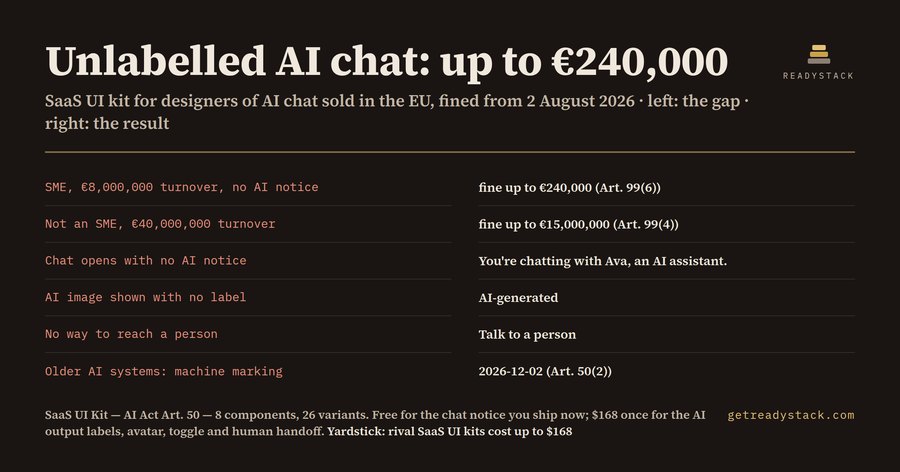
Up to €240,000 is the fine cap for an unlabelled AI chat — SaaS product designers at an EU SME with €8,000,000 turnover. This is the free checker's result for a SaaS with an AI chat assistant and AI image output, on the market before August, checked on 2026-09-27:

Fine cap (Art. 99(4) and 99(6)): up to €240,000 — 3% of €8,000,000 is lower than €15,000,000 Art. 50(1) tell people they are talking to an AI | from 2026-08-02 | applies — 56 days in force | AI chatbot notice (free), Assistant avatar, Human handoff button Art. 50(2) mark AI output machine-readable (system already on the market) | from 2026-12-02 | applies in 66 days | visible: AI content badge, Output label chip; metadata marking: not in a UI kit

Since 2 August 2026, Article 50 of the EU AI Act has applied to every SaaS product that talks to its users through an AI system. The rule in paragraph 1 is short: people must be told they are interacting with an AI system, at the latest at the first interaction. For a chat assistant that means before or at the very start of the conversation, not in the terms of service.

Article 99(4) sets fines for breaching Article 50 at up to €15,000,000 or 3% of total worldwide annual turnover for the preceding year, whichever is higher. Article 99(6) turns that around for SMEs and start-ups: whichever is lower. That is why the SME above lands at up to €240,000. A company that is not an SME with €40,000,000 turnover lands at up to €15,000,000, because the fixed amount is higher than 3% (€1,200,000).

The dates are not all the same. The machine-readable marking of AI-generated images, audio, video and text in Article 50(2) has one grace period, stated by the European Commission: systems already on the market before 2 August 2026 must comply from 2 December 2026. New systems have no grace period. The checker switches between the two dates when you tick whether your AI system was on the market before August.

A UI kit cannot do everything here, and we say so in the product. Machine-readable marking means metadata or a watermark inside the file; that is engineering work, not a component. What a design file can do is the visible part: the notice at the start of a chat, the label next to an AI-generated image, the disclosure on a deep fake or on AI text published to inform the public, and the button that gets a user to a person.

That is what the SaaS UI kit contains, counted: 8 components and 26 variants. The AI chatbot notice has 4 variants — chat start in English, chat start in German, a voice agent notice and the handoff to a human. The AI content badge has 4 (AI-generated, KI-generiert, Edited with AI, Human-reviewed). The output label chip has 3, the assistant avatar 3, the AI settings toggle 3, the "Why am I seeing this" tooltip 3, the human handoff button 3 and the AI answer card 3.

It ships three ways. A Figma plugin (manifest.json plus code.ts) builds the 8 components as real variant sets with text; you compile code.ts with tsc and import it as a development plugin. 26 SVG files paste into Figma as vectors. One .sketch file opens in Figma by drag and drop and in Sketch directly; it holds the variants as named, coloured shapes without text layers, so the labels come in through the SVGs or the plugin. Swap the colour tokens for your brand colours and rename the assistant "Ava". The checker is not legal advice; it applies the fine formula in Articles 99(4) and 99(6) and the dates in Article 113 and the Commission FAQ.

The free part is complete for one job: the four chatbot notice variants plus the checker. If your product only has a chat assistant, that is the Article 50(1) screen, done. The full kit is for what the notice leaves open once the AI also writes and draws for your users: the labels on its output, the avatar that shows who is answering, the toggle that turns AI suggestions off, and the path to a person. It is one payment, not a subscription.

15 seconds — what it actually does

Questions people ask

What does this SaaS UI kit contain?

Eight Figma components for the AI features of a SaaS product, 26 variants in total: AI chatbot notice (4), AI content badge (4), Output label chip (3), Assistant avatar (3), AI settings toggle (3), Why am I seeing this tooltip (3), Human handoff button (3) and AI answer card (3). They ship as a Figma plugin, 26 SVGs and one .sketch file.

Who is it for?

Product designers and design leads of SaaS products that added an AI assistant, AI writing or AI images and sell into the EU. Since 2 August 2026 Article 50 of the EU AI Act asks that users are told when they talk to an AI system and that deep fakes and some AI-generated text are disclosed. Sketch users open the same file.

Why not use a free Figma Community SaaS UI kit?

Free SaaS UI kits draw chat bubbles and cards, but none we know of ships an AI notice, an AI-generated label or a human handoff state. A chatbot cannot draw component variants for you. This kit ships that wording as real Figma variants in English and German, so you restyle it in one step instead of drawing it.

What is free?

The AI chatbot notice with 4 variants (chat start in English and German, voice agent, human handoff) as plugin, SVG and .sketch, plus the web checker: tick your AI features, enter your turnover, and it lists the Article 50 duties, their start dates and your Article 99 fine cap. The paid kit adds the labels for AI output and the handoff screens.

What does getting this wrong cost?

Article 99(4) of the AI Act sets fines for breaching Article 50 at up to €15,000,000 or 3% of worldwide annual turnover, whichever is higher; for SMEs Article 99(6) takes whichever is lower. An SME with €8,000,000 turnover faces up to €240,000. The full kit is a single payment, not a subscription.

Ask about this tool

One question, answered by the person who built it. Your email only if you want the answer sent.