· ReadyStack
Worked example
Real numbers from this tool, line by line.
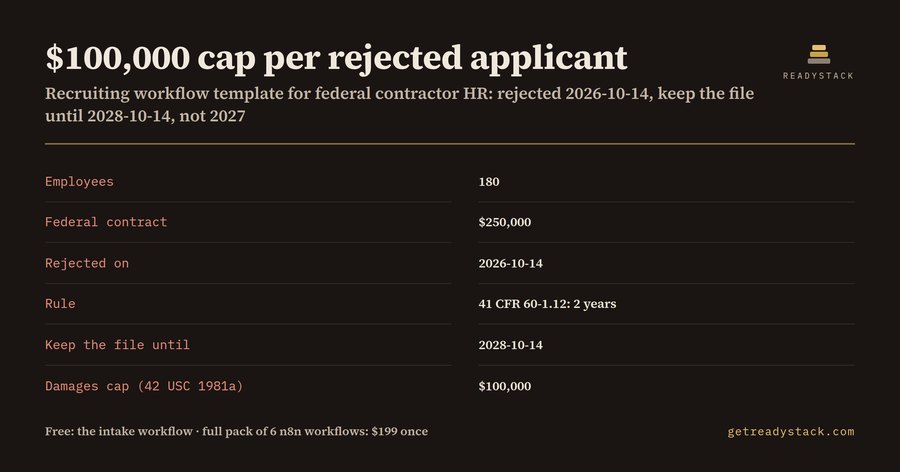
A federal contractor with 180 employees that rejects an applicant on 2026-10-14 must keep that file until 2028-10-14, and if it is gone when a charge arrives, HR defends a claim capped at $100,000 per applicant without it.
| Input | Value |
|---|---|
| Employees | 180 |
| Largest federal contract | $250,000 |
| Rejected on | 2026-10-14 |
| Rule that applies | 41 CFR 60-1.12, 2 years |
| Keep the file until | 2028-10-14 |
| Delete from | 2028-10-15 |
| EEOC charge window closes (300-day states) | 2027-08-10 |
| Title VII damages cap, 101 to 200 employees | $100,000 |
Change the headcount to 120 and the rule drops to 29 CFR 1602.14: one year, keep until 2027-10-14. Change it to 9 and there is no federal Title VII minimum at all, only your state law.
Why the one-year habit is wrong for contractors
Most HR teams keep applications for a year. That is 29 CFR 1602.14, and it is right for an employer with 15 or more employees and no large federal contract. But 41 CFR 60-1.12 doubles it to two years once you have 150 or more employees and a federal contract of at least $150,000. A purge at twelve months deletes a year of records you still owe.
The cost of deleting early is not a fine printed in the rule. It is the case you can no longer defend. Under 42 USC 1981a(b)(3) the Title VII cap on compensatory and punitive damages per complaining party is $50,000 for 15 to 100 employees, $100,000 for 101 to 200, $200,000 for 201 to 500 and $300,000 above 500. Once an EEOC charge is filed, 1602.14 also requires you to keep the records of every candidate for that position until final disposition.
The German side: keep less, not more
A German employer has the opposite problem. Under AGG §15(4) a rejected applicant has two months from receiving the rejection to claim in writing. If nothing arrives, the claim is time-barred and GDPR Art. 5(1)(e) says the data should go. If a written claim does arrive, ArbGG §61b(1) gives three months to sue, so the file stays at least that long. A rejection received on 2026-10-14 closes the claim window on 2026-12-14. For a role paying 4.500 € a month, AGG §15(2) caps compensation at 13.500 € (three monthly salaries) when the applicant would not have been hired anyway.
What the n8n recruiting workflow template does with your sheet
The free workflow takes each new applicant from your careers form by webhook, writes a row to your own Google Sheet with the rule that applies, a hold-until date and a delete-from date, and sends the applicant an acknowledgement email. It works alone: one import, your own Sheets and SMTP credentials, one test run.
After a few weeks the sheet raises the next questions, and the full pack of 6 workflows answers them:
- a rejection webhook that restarts the clock from the rejection date and sends the rejection email, so the German two-month window has a dated start;
- a legal-hold webhook for the day an EEOC charge or a written AGG claim arrives, which flags the row and emails HR and counsel;
- a daily digest of rows past their delete-from date and not on hold;
- a daily reminder for candidates stuck in one stage longer than your limit;
- a weekly CSV of every applicant by role, for an OFCCP desk audit or a works council.
The files hold no API keys: you attach your own credentials and edit one company block. Deleting a row stays a human decision.
Try the calculator with your own headcount and last rejection date before anything else. The answer is free and stays on the page.
15 seconds — what it actually does
Questions people ask
What does this recruiting workflow template do?
It stamps every applicant row in your Google Sheet with the retention rule that applies and a delete-from date. Example: 180 employees, a $250,000 federal contract, rejected 2026-10-14: 41 CFR 60-1.12 applies, hold until 2028-10-14, delete from 2028-10-15, and the Title VII damages cap is $100,000 per applicant.
Who is it for?
HR managers and in-house recruiters at US employers with 15 or more employees, including federal contractors, and at German employers, who track candidates in a Google Sheet and run n8n. For a German role paying 4.500 € a month, a rejection received 2026-10-14 opens an AGG claim window that ends 2026-12-14, with up to 13.500 € at stake per applicant.
Why not use a free recruiting template?
Free recruiting templates move candidates between stages. None of them knows that a federal contractor with 150 or more employees must keep applications for two years, or that a German AGG claim is barred two months after the rejection arrives. So nobody gets told when a rejected applicant's file may be deleted, or must still be kept.
What is free and what is paid?
Free: the intake workflow, which logs each new applicant with the rule and delete-from date and sends an acknowledgement email, plus the calculator on this page. Paid, one payment of $199: the full set of 6 workflows, adding the clock restart on rejection, legal hold when a claim arrives, the daily delete-due digest, stage reminders and the weekly disposition CSV.
What does getting it wrong cost?
Delete a rejected applicant's file too early and you defend the charge without it. Under 42 USC 1981a(b)(3) Title VII damages are capped at $50,000 for 15 to 100 employees, $100,000 for 101 to 200, $200,000 for 201 to 500 and $300,000 above 500, per complaining party. In Germany AGG §15(2) allows up to 3 monthly salaries per rejected applicant.
Ask about this tool
One question, answered by the person who built it. Your email only if you want the answer sent.