· ReadyStack
Worked example
Real numbers from this tool, line by line.
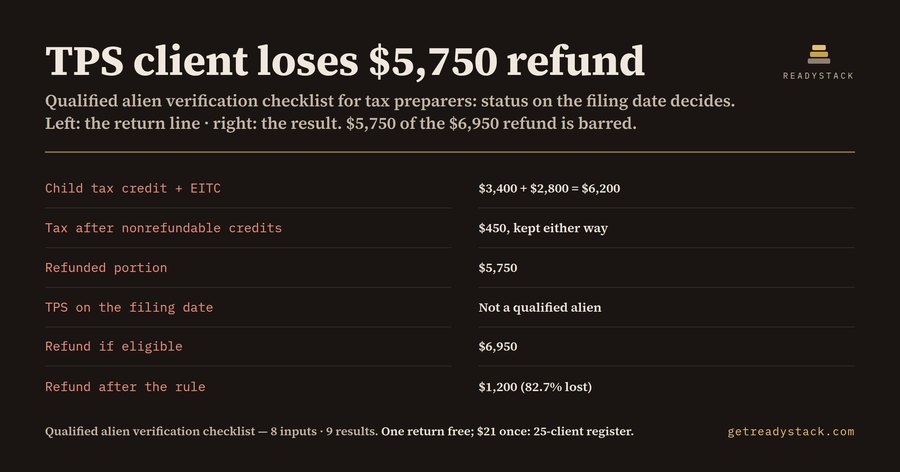
A TPS worker with two children loses $5,750 of a $6,950 refund under the IRS proposed rule, and tax preparers are the ones who have to catch it before filing.
Here is the return. Refundable child tax credit $3,400. Earned income credit $2,800. Tax after nonrefundable credits $450. Federal income tax withheld $1,200. The affected credits add up to $6,200. Take away the $450 of tax and the refunded portion is $5,750. Temporary Protected Status is not on the qualified alien list, so that $5,750 is barred. The refund falls from $6,950 to $1,200, a loss of 82.7%. The $1,200 of withholding still comes back.
What changed
On August 20, 2026 Treasury and the IRS published proposed regulations in the Federal Register (FR Doc. 2026-16985). They treat the refunded portion of four credits as a Federal public benefit under PRWORA: the adoption credit, the child tax credit, the American opportunity credit and the earned income credit. Only a U.S. citizen, a U.S. national or a qualified alien may receive it.
The refunded portion is the sum of those credits minus tax after nonrefundable credits. The part that offsets tax is kept either way.
Who is a qualified alien
8 U.S.C. 1641(b) lists lawful permanent residents, asylees, refugees, people paroled for at least 1 year, people whose deportation is withheld, conditional entrants before April 1, 1980, Cuban and Haitian entrants and Compact of Free Association residents. Section 1641(c) adds certain battered spouses and children.
TPS, DACA, nonimmigrant visas such as H-1B or F-1, and parole of less than 1 year are not on that list. A client can hold a work-eligible SSN and still fail this test. Tax software checks the SSN, not the status.
The date that decides it
Status counts on the day the return that first claims the credit is filed. That can be an early, a late or an amended return. If a client first claims the credit while not qualified and gains status later, an amended return does not bring the refunded portion back. If the credit is first claimed on an amended return after the status change, it is allowed.
Joint returns
If one spouse is a U.S. citizen, U.S. national or qualified alien, the other spouse is treated as a qualified alien. An H-1B worker married to a U.S. citizen keeps the whole refund on a joint return.
The declaration
When there is a refunded portion, the taxpayer or one spouse declares status under penalty of perjury on the form the IRS prescribes. Section 7206 carries a fine of up to $100,000 and up to 3 years.
How big this is
Treasury estimates 200,000 to 700,000 taxpayers will be ineligible for tax year 2026, with an average refunded portion of $3,656. The rule is proposed to apply to taxable years ending on or after the date the final regulations are published.
Check one return free
Type the four credits, the tax and the withholding, then pick each spouse's status from the checklist. You get 9 results: affected credits, refunded portion, the part kept against tax, the status test, whether a declaration is needed, the refund if eligible, the dollars barred, the refund after the rule and the share lost. Nothing is uploaded.
15 seconds — what it actually does
Questions people ask
What does the qualified alien verification checklist do?
It adds a client's refundable child tax credit, earned income credit, refundable AOTC and refundable adoption credit, subtracts tax after nonrefundable credits, and shows the refunded portion that the August 20, 2026 proposed rule treats as a Federal public benefit. Then it checks the client's status on the filing date against the 8 U.S.C. 1641 list and shows the dollars barred.
Who is it for?
US tax preparers, enrolled agents and VITA volunteers who file returns for immigrant families claiming the child tax credit, EITC, American opportunity credit or adoption credit. Under the proposed rule they must ask whether the taxpayer, or one spouse on a joint return, is a U.S. citizen, U.S. national or qualified alien on the day the return is filed.
Why not just check for a valid SSN?
Because a work-eligible SSN is not the test. TPS holders, DACA recipients and nonimmigrant workers such as H-1B holders can have one, yet they are not on the qualified alien list in 8 U.S.C. 1641(b). Under the proposed rule they keep the part of the credits that offsets their tax but lose the refunded portion.
What is free and what is paid?
Free: the full check for one return, as often as you like, with no sign-up: all 9 results, the status checklist and the joint-return rule. Paid, $21 once: an .xlsx Client Register for 25 returns with filing date, status category, barred amount and declaration flag per client, plus the status checklist and timing rule as a sheet you keep in the file.
What does it cost compared with doing it by hand?
BLS OEWS 2025 puts the median tax preparer at $26.40 an hour. Treasury estimates the average refunded portion at $3,656 for 2026 and expects 200,000 to 700,000 taxpayers to be ineligible for it. One wrong status call on a return costs the client that refund, or exposes a false declaration under section 7206.
Ask about this tool
One question, answered by the person who built it. Your email only if you want the answer sent.