Portfolio UI Kit — GDPR Two-Click Embeds & Consent Banner

For freelance designers and photographers whose portfolio site is open to EU visitors. Your checked result is below; change the ticks to see your own.

EmbedLoads fromIP goes toFix in this kit

Full version — $168 once One payment, not a subscription. You have already seen your own answer above before paying.
What your portfolio embeds
Free: the Two-click embed placeholder (4 variants) — a complete piece on its own: nothing loads until the visitor clicks.
Click to load Google Maps · your IP goes to GoogleClick to load Instagram post · your IP goes to MetaClick to load Vimeo video · your IP goes to VimeoClick to load YouTube video · your IP goes to Google
Free download: Figma plugin, 4 SVGs and a .sketch. The full kit adds what the placeholders create the need for: the consent banner (Accept all and Reject all at equal weight), category toggles that start off, an always-load checkbox that starts unticked, contact fields, project tags and nav tabs — 8 components, 27 variants.
Why a free portfolio UI kit does not do this
Free portfolio UI kits show the raw YouTube or Vimeo frame and a banner with only "Got it". The CNIL fined Google €150 million and Facebook €60 million on 2021-12-31 because refusing cookies took more effort than accepting. CJEU Planet49 (C-673/17, 2019-10-01): a pre-ticked box is not consent. GDPR Art. 7(3): withdrawing must be as easy as giving.
How to get it into Figma
  1. In Figma, drag the .sketch file onto the file browser to open it.
  2. SVG files: copy and paste them into a frame — they come in as vectors.
  3. Plugin: it ships as TypeScript (code.ts); run tsc to get code.js, then import manifest.json as a development plugin. It rebuilds the components as real variant sets.
Menu names differ by Figma version and UI language. The .sketch holds named, brand-coloured shapes without text layers — labels come in with the SVGs and the plugin; some component structure may be simplified in the .sketch import (not measured). What you gain: Sketch users open the same file. This is a design kit, not legal advice.

Rival portfolio UI kits on this shelf list at up to $168 (our shelf measurement, 2026). getreadystack.com

Get the complete version $168

This page is the working piece. The full pack has everything below.

8 components, 27 variants for portfolio sites that embed YouTube, Vimeo, Google Maps or Instagram: two-click placeholders, an Accept all / Reject all banner of equal weight and unticked defa

LG München I, judgment of 2022-01-20 (3 O 17493/20): a website that loaded Google Fonts from Google's servers passed the visitor's IP address to Google without consent; the court awarded the visitor €100 damages and ordered it to

Buy the full version — $168
ENDEJAESPT

Find a tool

· ReadyStack

Worked example

Real numbers from this tool, line by line.
Portfolio UI Kit — GDPR Two-Click Embeds & Consent Banner (Figma)

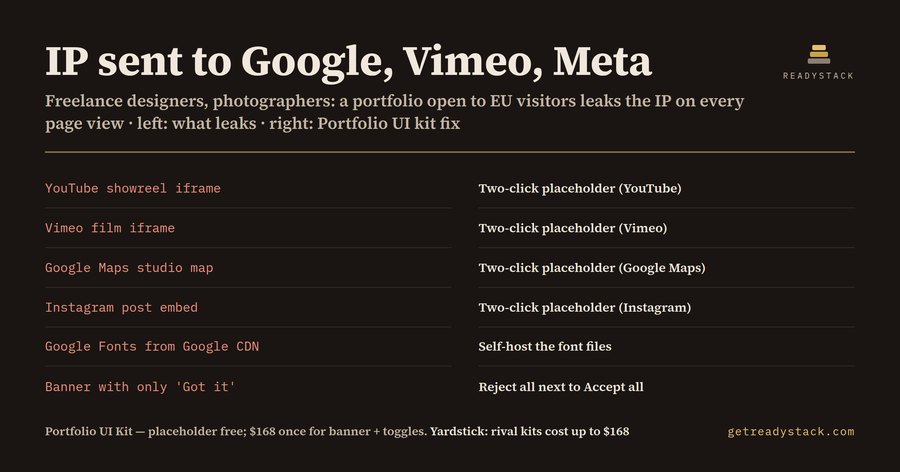
Your portfolio page probably loads things you never think about. A showreel from YouTube or Vimeo, a studio map from Google Maps, a strip of Instagram posts, and a typeface pulled from the Google Fonts CDN. Each of those is a request to another company's server, and each request carries the visitor's IP address. It happens the moment the page opens, before the visitor has clicked anything.

We built a small checker for exactly this and ran the most common portfolio setup through it: YouTube, Vimeo, Google Maps, Instagram and Google Fonts from the Google CDN. Result: 5 embeds, 3 companies (Google, Vimeo, Meta), all receiving the IP address before any click. Tick only Google Fonts and the answer changes: 1 embed, 1 company, and the fix is to self-host the font files, with no banner needed at all. Add Google Analytics and Calendly to a YouTube embed and you get 3 embeds, 2 companies and a banner with 3 category toggles.

Why this matters for a freelancer in particular: on 2022-01-20 the LG München I (3 O 17493/20) ruled on a site that loaded Google Fonts from Google's servers. The visitor's IP address went to Google without consent; the court awarded that visitor €100 and ordered the site to stop. A portfolio is a small site, but the fact pattern is the same one.

The second trap is the banner itself. Many portfolio templates show a banner with a single "Got it" or "Accept" button and hide refusing behind a settings link. The CNIL fined Google €150 million and Facebook €60 million in decisions dated 2021-12-31, because refusing cookies took more effort than accepting them. And the CJEU in Planet49 (C-673/17, 2019-10-01) held that a pre-ticked checkbox is not valid consent. GDPR Art. 7(3) adds that withdrawing consent must be as easy as giving it.

So a portfolio page that handles this well needs a few specific pieces. First, a placeholder in front of each embed: a card that says what will load and which company gets the IP address when the visitor clicks. Second, a consent banner where Reject all has the same weight as Accept all. Third, category toggles that start off, and a way to take consent back later. Fourth, any "always load YouTube" checkbox has to start unticked.

That is what the Portfolio UI Kit contains, drawn as Figma components with variants: Two-click embed placeholder (4 variants: YouTube, Vimeo, Google Maps, Instagram), Consent button (4), Consent banner (3: first visit, choice saved, consent withdrawn), Consent category toggle (3), Always-load checkbox (3), Contact form field (3), Project tag (4) and Portfolio nav tab (3). That is 8 components and 27 variants. It ships as a Figma plugin (TypeScript source you compile with tsc), 27 SVGs you paste as vectors, and a .sketch file Figma opens by drag and drop. The .sketch holds named, coloured shapes without text layers, so the labels come from the SVGs and the plugin.

The placeholder card is free, with all 4 variants, together with the checker. On its own it does the core job: nothing loads until the visitor clicks. What you notice after using it is the next gap: once a visitor has clicked, the site should remember that choice and let them take it back. That is the paid part.

Start with the checker. Tick what your page embeds and read which companies get your visitors' IP addresses today. This is a design kit, not legal advice; your developer still has to wire each iframe to load only after the click.

15 seconds — what it actually does

Questions people ask

What does this portfolio UI kit contain?

Eight Figma components for a designer or photographer portfolio page, 27 variants in total: Two-click embed placeholder (4), Consent button (4), Consent banner (3), Consent category toggle (3), Always-load checkbox (3), Contact form field (3), Project tag (4) and Portfolio nav tab (3). They come as a Figma plugin, 27 SVGs and one .sketch file.

Who is it for?

Freelance designers, photographers, illustrators and small studios whose portfolio site is open to visitors in the EU and embeds YouTube, Vimeo, Google Maps, Instagram or Google Fonts. If your showreel or map loads the moment the page opens, the visitor's IP address has already gone to Google, Vimeo or Meta before they could say yes.

Why not use a free portfolio UI kit?

Free portfolio UI kits show the raw YouTube or Vimeo frame and a cookie banner with only 'Got it'. The CNIL fined Google €150 million and Facebook €60 million on 2021-12-31 because refusing took more effort than accepting. This kit draws Reject all at the same weight as Accept all and a placeholder in front of every embed.

What is free?

The Two-click embed placeholder with 4 variants (YouTube, Vimeo, Google Maps, Instagram) as a plugin, SVGs and .sketch, and the web checker that lists which of your own embeds send the visitor's IP address before consent. That alone keeps the embeds on your page from loading until the visitor clicks. No account is needed.

What does getting it wrong cost?

On 2022-01-20 the LG München I (3 O 17493/20) awarded a visitor €100 damages because a website loaded Google Fonts from Google and passed on his IP address without consent, and ordered the site to stop. Rival portfolio UI kits on this shelf list at up to $168; this one is a single payment and adds the consent states.

Ask about this tool

One question, answered by the person who built it. Your email only if you want the answer sent.