· ReadyStack
Worked example
Real numbers from this tool, line by line.
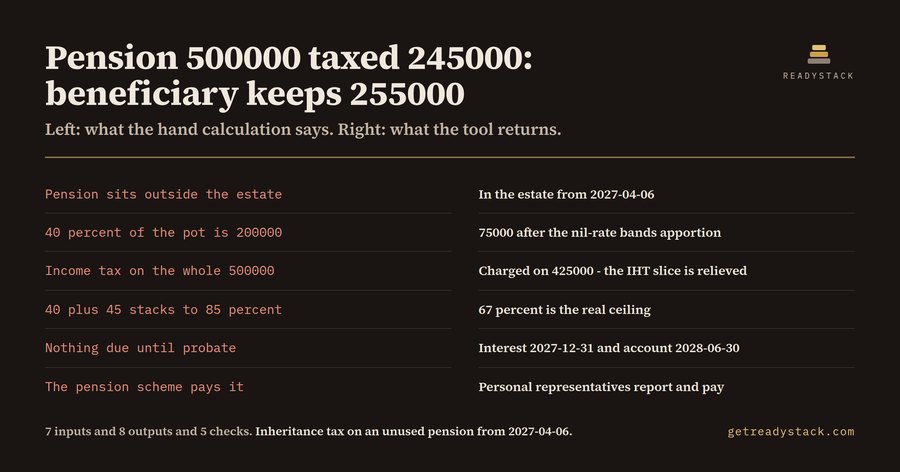
A UK executor closing an estate with a 500000 unused pension pot now has 245000 of tax to find and 255000 to hand to the beneficiary - and neither figure is 40 percent of anything.
The Finance Bill received Royal Assent on 2026-03-18. From 2027-04-06 most unused pension funds and lump sum death benefits form part of the member's estate for inheritance tax, and the personal representatives - not the scheme administrator - report and pay it. That is a new job landing on private-client paralegals, paraplanners and lay executors, and it is a job that hand arithmetic gets wrong in two opposite directions.
The pot does not get its own nil-rate band
The nil-rate bands belong to the whole estate, so the pension carries only its pro-rata share of the estate's inheritance tax. Take the defaults shipped in the tool: a 500000 unused pot, 300000 of other estate, 500000 of nil-rate bands available. The estate's taxable value is 300000, the estate's inheritance tax is 120000, and the pension's share of it is 75000, because the pot is five eighths of the estate.
Charge a flat 40 percent on the pot instead and you get 200000. That is an overstatement of 125000 on a single estate, and it is the answer most people reach for first.
Income tax does not land on the whole pot either
Where the member died at 75 or over, the beneficiary still pays income tax on what they draw, at their own marginal rate. The regulations relieve income tax on the portion equal to the inheritance tax due on that pension, so the higher-rate beneficiary in the default case is taxed on 425000, not on 500000. That is 170000.
Total tax 245000. Net 255000. Effective rate 49 percent on the pot.
The naive version stacks 40 percent and then 45 percent on the same money and reports 85 percent. The real ceiling for an additional-rate beneficiary on a fully taxable pot is 67 percent. Both numbers are alarming; only one of them is true, and the difference is the size of a small flat.
Two dates belong to the personal representatives
Interest runs from the end of the sixth month after the month of death. The account and the penalty exposure follow twelve months after the month of death. For a death on 2027-06-10 those dates are 2027-12-31 and 2028-06-30, and the tool prints both. A scheme withholding notice cannot be given more than 15 months after the end of the month in which the member died.
What stays out
A pot passing to a surviving spouse or civil partner, or to a registered charity, carries no inheritance tax. Death-in-service benefits, dependants' scheme pensions and joint-life annuities stay outside the member's estate. But income tax can still apply to a surviving spouse where the member died at 75 or over: on the same 500000 pot that case returns 0 inheritance tax and 200000 of income tax, a 40 percent effective rate.
Why not just ask a chatbot
Most models were trained before 2026-03-18 and still answer that pensions sit outside the estate. The ones that know about the change usually apply the flat 40 percent, or stack the two taxes on the same money. Either way the number you paste into a file note is wrong, and the personal representatives are the ones who sign for it.
The browser extension and the free web page run the same seven inputs and eight outputs, with no key, no watermark and no run limit. The 60 dollar licence key is for a different job: a .csv audit row per estate, and browser alarms for the six-month interest date and the twelve-month account date on every case you enter.
Questions people ask
What does this actually work out?
You type seven things about one estate - the unused pot, the rest of the estate, the nil-rate bands available, who receives it, whether the member died at 75 or over, the beneficiary's tax band and the date of death - and it returns eight answers: scope, the IHT on the pot, the income tax, the total, the net, the effective rate, the interest date and the account date.
Who is it for?
UK personal representatives, private-client paralegals, paraplanners and IFAs. From 2027-04-06 the personal representatives, not the pension scheme, report and pay the inheritance tax on an unused pot, so the person doing the estate paperwork needs the number long before probate is granted.
Why will a chatbot not do this?
Most models were trained before the Finance Bill got Royal Assent on 2026-03-18 and still say pensions sit outside the estate. The ones that know about the change usually charge 40 percent of the whole pot and then add income tax to the whole pot again, which overstates the bill badly.
What is free and what needs the key?
Every calculation is free and unlimited: all seven inputs, all eight outputs, in the popup and on the web page, with no watermark and no run limit. The 60 dollar key adds a different job - a .csv audit row per estate and browser alarms for the six-month interest date and the twelve-month account date.
What would this cost from a person?
A UK independent financial adviser charges roughly 150 to 350 pounds an hour in 2026 and an inheritance tax solicitor 265 to 390 plus VAT, so having one estate's pension figure worked up is about a 300 pound job. The extension is 60 dollars once, for every estate you handle.
Ask about this tool
One question, answered by the person who built it. Your email only if you want the answer sent.