· ReadyStack
Worked example
Real numbers from this tool, line by line.
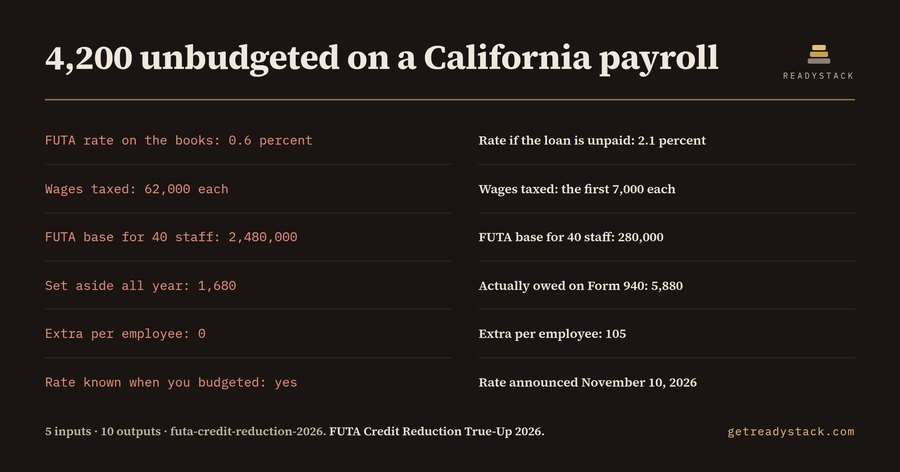
Forty people on a California payroll, 62,000 average wages, and the FUTA line in the accrual is short by 4,200 dollars - 105 dollars per employee - money the payroll system never set aside because it charged 0.6 percent all year. That is the arithmetic every US bookkeeper with California or U.S. Virgin Islands staff meets in November.
FUTA is 6.0 percent on the first 7,000 dollars of each employee's wages. Employers who pay their state unemployment tax on time get a 5.4 percent credit against it, which is why the number in your chart of accounts is 0.6 percent. But when a state borrows from the federal unemployment account and has not repaid the loan by November 10, the Department of Labor cuts that credit. The reduction starts at 0.3 percent in the second year the loan is outstanding and climbs another 0.3 points each year it stays outstanding.
Two things make this expensive. The first is that the reduction is retroactive: announced after November 10, applied to the whole calendar year, including wages you paid in February and budgeted at 0.6 percent. The second is that FUTA is charged per employee on the first 7,000 dollars, not on total payroll. A landscaping company with 150 seasonal workers at 4,200 dollars each has a smaller payroll than a 40-person office but a bigger FUTA base: 630,000 dollars against 280,000. At California's confirmed 1.2 percent reduction for tax year 2025, that seasonal employer owes 7,560 dollars of extra tax, against 4,200 for the office at the 1.5 percent 2026 step.
The list is the hard part to look up. For tax year 2025 the reduction states are California at 1.2 percent and the U.S. Virgin Islands at 4.5 percent. New York is not one - it repaid its loan - and neither is Connecticut or Illinois, which appeared on older lists. Ask a language model and you will often get New York back, because the list changed after its training data was written. Free FUTA calculators hard-code the 0.6 percent net rate with no credit-reduction field at all.
The extension is the arithmetic in between. You pick the state and the rate scenario - the confirmed 2025 figure, or the 0.3-point step that state would take for 2026 if the loan is still unpaid on November 10, 2026 - then enter headcount, average wage, and the rate your payroll system has been accruing at. It caps every worker at the first 7,000 dollars, charges 0.6 percent plus the reduction, and returns the taxable wage base, the extra tax, the extra per employee, the shortfall against your accrual, and the total for Form 940.
It holds the dates too. Form 940 for tax year 2026 is due February 1, 2027 - January 31 falls on a Sunday. Enter the date you will actually pay and the tool applies the late-payment penalty under IRC 6651(a)(2): 0.5 percent of the unpaid tax per month or part month, capped at 25 percent. For the seasonal employer above, paying on April 1 instead of February 1 adds 113.40 dollars to an 11,340 dollar bill.
All of that is free and needs no key: any state, any headcount, any wage, no watermark, no usage limit. Ten figures come back from five inputs. The paid tier sits on a different axis - ownership and repetition, not scope. Twenty-nine dollars once buys a .csv export you keep and hand to your accountant, plus browser alarms for the November 10 announcement and the February 1 filing date. An outside payroll accountant re-running Schedule A is one to two billable hours at 50 to 150 dollars an hour, every year the list changes. Payroll numbers never leave the machine; the only outbound request is licence-key validation.
Questions people ask
What does the FUTA credit reduction calculator actually do?
It takes your headcount in one state, your average wage, and the credit reduction rate, then charges FUTA correctly: 0.6% plus the reduction on the first $7,000 of each employee's wages, not on total payroll. It returns the extra tax, the extra per employee, the shortfall against your accrual, and the late-payment penalty if you pay after February 1, 2027.
Who is this for?
US employers, in-house payroll managers and bookkeepers who run wages in California or the U.S. Virgin Islands - the two jurisdictions carrying a FUTA credit reduction for tax year 2025. It matters most to seasonal, hourly and high-turnover employers, because the reduction is charged per employee on the first $7,000, so headcount drives the bill, not payroll size.
Why not just ask a chatbot or use a free calculator?
The credit reduction list changes every year and is only settled after November 10. Language models still name New York and Connecticut as reduction states from older training data, and generic free FUTA calculators apply one flat 0.6% with no reduction field at all. Both give you a number that is wrong in the direction that costs money.
What is free and what needs the key?
Every calculation is free, with no key, no watermark and no usage limit: run any state, any headcount, any wage, as often as you like. The $60 key adds two things on a different axis - a .csv export of the worked figures that you keep, and browser alarms for the November 10 announcement and the February 1 filing date.
What would this cost me otherwise?
Having an outside payroll accountant re-run Form 940 Schedule A is one to two billable hours at typical US bookkeeping rates of $50-$150 an hour, and you pay it again each year the list changes. If the shortfall means you under-deposit, the IRS late-payment penalty is 0.5% of the unpaid tax per month, capped at 25%.
Ask about this tool
One question, answered by the person who built it. Your email only if you want the answer sent.