· ReadyStack
Worked example
Real numbers from this tool, line by line.
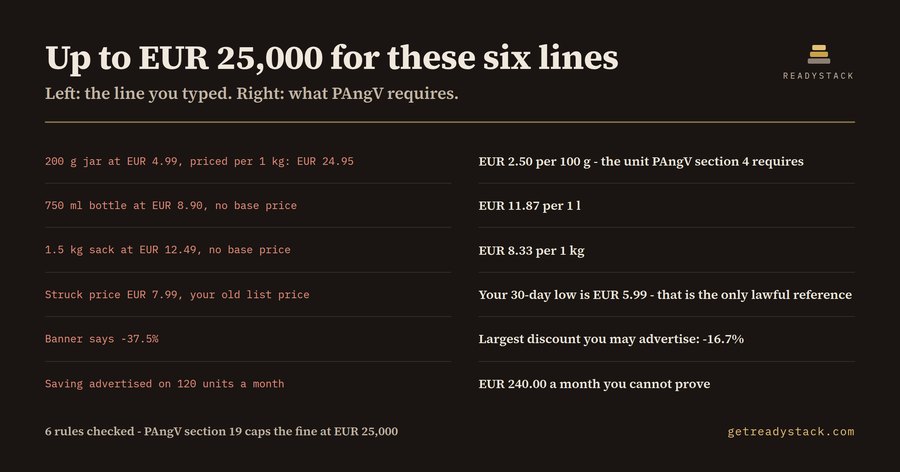
Up to EUR 25,000 - that is the fine PAngV section 19 allows for one wrong price line, and the shops it reaches are Shopify and WooCommerce sellers shipping to consumers in Germany and Austria.
Line checked: 200 g jar, EUR 4.99 now, EUR 7.99 struck through, lowest price of the last 30 days EUR 5.99, 120 units a month, no base price on the listing.
- Required reference unit: 100 g
- Required base price (Grundpreis): EUR 2.50 per 100 g
- Figure for the other unit, not the legal one: EUR 24.95 per 1 kg
- Discount your banner claims: -37.5%
- Largest discount you may advertise: -16.7%
- Over-claim: 20.8 points
- Saving you cannot prove, per month: EUR 240.00
- Rules failed: 3 of 6
- What a trade association would cite: base price not displayed; struck price above the 30-day low of EUR 5.99; discount over-claimed by 20.8 points
Two rules produced that block, and both of them are arithmetic.
The first is the base price, the Grundpreis. German shops must print the price per reference unit next to the pack price. The reference unit is 1 kg or 1 l - except that PAngV section 4 lets you use 100 g or 100 ml where the nominal quantity does not exceed 250 g or 250 ml. That exception is where converters fail. Take the 200 g jar at EUR 4.99. The lawful line is EUR 2.50 per 100 g. A generic unit-price tool divides by weight, prints EUR 24.95 per 1 kg, and the listing now shows a number ten times the one the customer is entitled to compare. Run the same tool over a 750 ml bottle at EUR 8.90 and the answer flips: 750 is above 250, so the lawful line is EUR 11.87 per 1 l. A 1.5 kg sack at EUR 12.49 is EUR 8.33 per 1 kg. Three products, three different reference units, and no rule of thumb that survives all three.
The second is the reference price behind a discount. Since the Omnibus rules landed in PAngV section 11, an announced price reduction must be measured against the lowest total price you charged in the 30 days before the reduction - not the price you charged last quarter, and not the price you raised the item to a week before the sale. The jar at EUR 4.99 with EUR 7.99 struck through advertises -37.5%. Because the lowest price in the last 30 days was EUR 5.99, the largest discount that shop may advertise is -16.7%. The banner over-claims by 20.8 points, and at 120 units a month it advertises EUR 240.00 of saving a month that the shop cannot document. Comparing against a manufacturer's RRP is a different case and still allowed; comparing against your own earlier price is the one the 30-day window governs.
This extension puts both rules in the browser tab where the listing is edited. You fill in one product line - pack quantity and unit, the price you charge, the struck-through price on the page, your lowest price of the last 30 days, the units you sell a month, and two boxes for what the listing actually displays - and it returns every figure in the block above, including how many of the 6 rules that line fails and the sentence a trade association would cite.
Black Friday 2026 falls on 2026-11-27. Every banner that goes live that morning carries a reference price, and every reference price has a 30-day history behind it. Check the line before the campaign, not after the letter.
Nothing is held back. The free layer runs all 6 rules, every pack size, unlimited lines, no key, no cap, no watermark, and no product data leaves the machine - the only outbound call the extension makes is licence-key validation. The $60 licence key adds a different axis: CSV export of a whole catalogue check to hand to a developer or a lawyer, and a 30-day alarm that fires before a running promotion outlives its reference price. For scale, German shop-law subscriptions that supply legal texts and price-display guidance run about EUR 10 to 50 per month, every month.
15 seconds — what it actually does
Full walk-through
Questions people ask
What does this extension actually do?
It takes one product line - pack size, unit, the price you charge, the struck-through price you show, and your own lowest price of the last 30 days - and returns the base price Germany requires, the correct reference unit (100 g or 1 kg), the largest discount percentage you may legally advertise, and which of the 6 rules that line fails right now.
Who is this for?
Shopify, WooCommerce, Etsy and Amazon sellers who ship to consumers in Germany or Austria, and the freelancers who maintain those shops. If a listing shows a price per pack, a struck-through price or a percentage off, the German Price Indication Ordinance (PAngV) applies to that listing even when your company sits outside the EU.
Why is a free unit-price converter not enough?
Free converters divide price by weight and stop. They print per 1 kg for every pack, so a 200 g jar at EUR 4.99 comes out as EUR 24.95 instead of the EUR 2.50 per 100 g that PAngV section 4 allows, and none of them compare your struck price against your own lowest price of the last 30 days, which is where a discount claim actually breaks.
What is free and what needs the key?
Free covers the whole calculation: all 6 rules, every pack size, unlimited product lines, no key, no cap, no watermark. The $60 licence adds a different axis - CSV export of a full catalogue check to hand to a developer or a lawyer, and a 30-day alarm that fires before a running promotion outlives its reference price.
What does the alternative cost?
German shop-law subscriptions that supply legal texts and price-display guidance run roughly EUR 10 to 50 per month, every month, and a single lawyer review of one campaign costs more than a year of that. This extension is $60 once, runs in the browser tab where you edit the listing, and sends no product data anywhere.
Ask about this tool
One question, answered by the person who built it. Your email only if you want the answer sent.