· ReadyStack
Worked example
Real numbers from this tool, line by line.
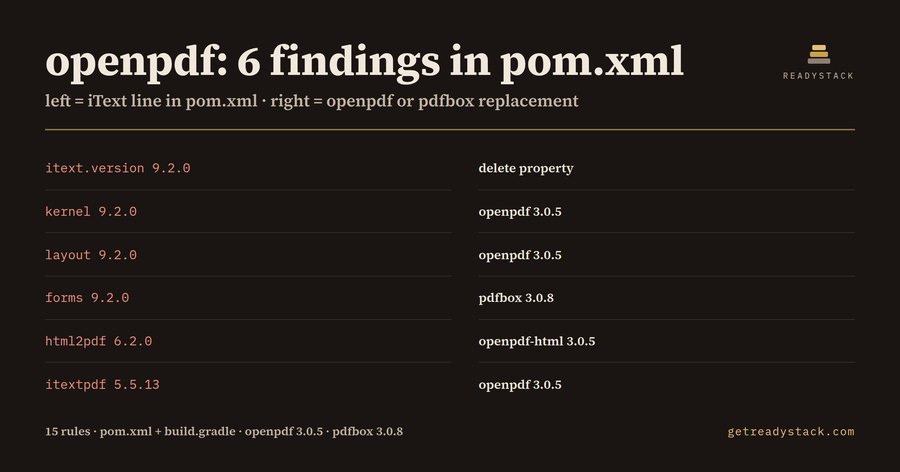
6 findings in one pom.xml: that is what a Java invoice service on iText 9.2.0, with one legacy iText 5.5.13 module, shows when every iText line is mapped to OpenPDF or Apache PDFBox. If you are a Java team shipping closed-source software or a SaaS backend that renders PDFs, this is the list you need before the next release.
What iText says
iText's licensing page is short and plain: "iText 5 and all subsequent versions of iText are dual-licensed, and available under open source (AGPLv3) or commercial license agreements." Under the AGPLv3 option: "You may not deploy it on a network without disclosing the full source code of your own applications under the AGPL license." So a closed product or a web service on iText 7, 8 or 9 either publishes its source or holds a commercial licence. iText publishes no price on that page.
The two open replacements
Both are on Maven Central (checked 2026-09-30):
- OpenPDF
com.github.librepdf:openpdf:3.0.5, LGPL 2.1 / MPL 2.0, plusopenpdf-html:3.0.5for HTML to PDF - Apache PDFBox
org.apache.pdfbox:pdfbox:3.0.8, Apache 2.0, pluspreflight:3.0.8for PDF/A checks
OpenPDF is the natural home for code that builds documents (Document, Paragraph, PdfPTable). PDFBox is the home for code that opens existing PDFs, fills AcroForms or signs.
One trap: OpenPDF 3 moved its classes from com.lowagie.text to org.openpdf.text. Many snippets online, and many chatbot answers, still import com.lowagie, which does not compile against 3.0.5.
The sample pom.xml, line by line
<itext.version>9.2.0</itext.version>
<artifactId>kernel</artifactId>    <!-- ${itext.version} -->
<artifactId>layout</artifactId>
<artifactId>forms</artifactId>
<artifactId>html2pdf</artifactId>  <!-- 6.2.0 -->
<artifactId>itextpdf</artifactId>  <!-- 5.5.13 -->
The check resolves ${itext.version} and reports:
itext.version9.2.0: delete it once the last iText line is gonekernel9.2.0 →openpdf3.0.5 to write,pdfbox3.0.8 to read or editlayout9.2.0 →openpdf3.0.5forms9.2.0 →pdfbox3.0.8 (PDAcroForm)html2pdf6.2.0 →openpdf-html3.0.5itextpdf5.5.13 →openpdf3.0.5, importscom.itextpdf.textbecomeorg.openpdf.text
Each finding carries the ready-made <dependency> block, or implementation(...) for Gradle Kotlin DSL.
Gradle projects
The same 15 rules read build.gradle and build.gradle.kts: string coordinates, group:/name: maps, and version variables such as itextVersion. A Kotlin DSL file with the itext-core 9.8.0 bundle, sign and the Bouncy Castle adapter gives 3 findings: split the bundle by job, move signing to PDFBox, drop the adapter.
What it will not do
It is a dependency map, not legal advice. It reads the file in front of it, not the resolved tree, so run mvn dependency:tree to catch iText pulled in by another library.
Try it
Open your pom.xml in VS Code with the extension, or paste it into the web page. The whole map is free. A licence key adds the whole workspace as one dated migration plan and a CI gate that fails a build adding new com.itextpdf use.
15 seconds — what it actually does
Questions people ask
What does OpenPDF Migration Check do?
It reads a pom.xml, build.gradle or build.gradle.kts and lists every iText (com.itextpdf) dependency with its line number and the exact OpenPDF 3.0.5 or Apache PDFBox 3.0.8 line that replaces it. It has 15 rules. On the bundled sample pom.xml it reports 6 findings: kernel, layout, forms, html2pdf, itextpdf 5.5.13 and the itext.version property.
Who is the iText to OpenPDF check for?
Java teams that ship closed-source software or run a SaaS backend and generate PDFs with iText 5, 7, 8 or 9. iText states that iText 5 and all later versions are dual-licensed AGPLv3 or commercial, so those teams either publish their application source or move to OpenPDF or Apache PDFBox.
Why not just ask a chatbot or grep for itext?
A grep finds the word itext but does not say which library replaces each module: forms and sign go to PDFBox, layout goes to OpenPDF, html2pdf goes to openpdf-html. Chatbot snippets often import com.lowagie.text, which OpenPDF 3 renamed to org.openpdf.text. The check gives the replacement line per module, with current versions from Maven Central.
What is free and what needs a licence key?
Free, without a key: the open file, all findings from the 15 rules, and every replacement line. A licence key adds the whole workspace at once as one dated migration plan, every module and iText artifact mapped to its replacement, and a CI gate that fails a build adding new com.itextpdf use. One payment, not a subscription.
What does the alternative cost?
Staying on iText in closed-source or SaaS code means a commercial iText licence; iText publishes no price on its AGPLv3 page. Switching to another commercial Java PDF library costs money too: Aspose.PDF for Java lists its Developer Small Business licence at US$1,199 per developer. OpenPDF and Apache PDFBox are open source.
Ask about this tool
One question, answered by the person who built it. Your email only if you want the answer sent.