· ReadyStack
Worked example
Real numbers from this tool, line by line.
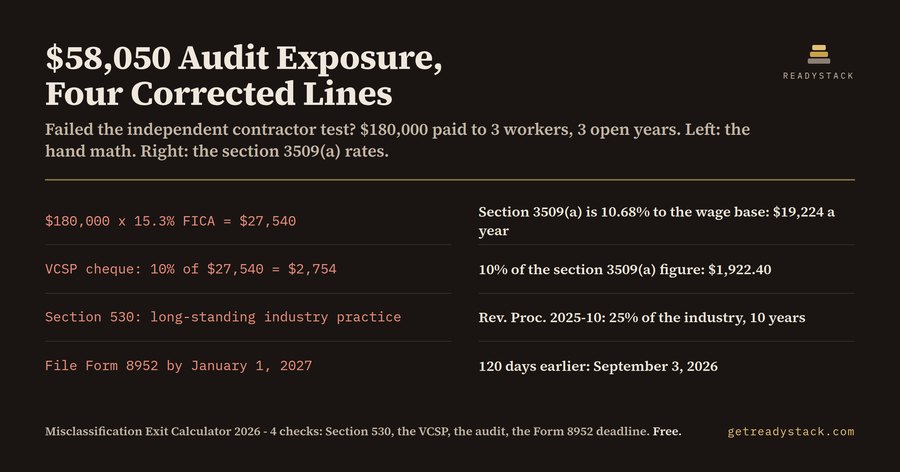
A US bookkeeper with three 1099 contractors and $180,000 of 2026 pay is sitting on $58,050 of employment-tax exposure, and can close it for $1,922.40.
That gap is not a rounding error. It is the difference between the number almost everyone reaches for and the number the statute actually uses.
The wrong rate is the default rate
Ask a payroll calculator what a misclassified worker costs and it charges full FICA: 15.3% of $180,000 is $27,540. Ask a chatbot and you will usually get the same rate, plus a citation to Rev. Proc. 85-18 for the Section 530 safe harbour.
Both are wrong, for the same reason: a misclassification does not settle at the ordinary rate.
Section 3509(a) charges 1.5% for the income tax you failed to withhold, 20% of the employee's 7.65% FICA share, and the employer's full 7.65% match. Add those and you get 10.68% of pay up to the social security wage base ($184,500 for 2026) and 3.24% above it. Those are the rates the IRS publishes in its own VCSP FAQ.
On $180,000 across three workers that is $19,224 a year, not $27,540. Over three open years, with FUTA, $58,050.
And if a Form 1099 is missing, the 1.5% and 20% double to 3% and 40%. The same facts then cost $74,412. Filing the late returns is worth $16,362 before anything else happens.
There are three doors, not one
Section 530 is the only free exit. It needs reporting consistency, substantive consistency, and a reasonable basis. In January 2025 the IRS issued Rev. Proc. 2025-10, its first update to Section 530 in forty years, and it put numbers on the vague part: 25% of an industry, excluding you, is deemed a significant segment, and 10 years is deemed long-standing. If you have been telling yourself "everyone in my trade does this," that sentence is now testable.
The VCSP is the cheap paid exit: 10% of the section 3509(a) figure for the most recent tax year, with the wage base applied per worker. On the facts above, $1,922.40. No interest, no penalties, and no employment tax audit of prior years for those workers. It closes on you if a required Form 1099 is missing for any of the 3 preceding calendar years, or if you are already under examination.
Doing nothing is the third door, and it is priced above.
The date almost nobody works backwards
Form 8952 goes in at least 120 days before the date you want the workers on payroll. A clean January 1, 2027 start therefore had a filing deadline of September 3, 2026. That date has passed. File today and the earliest reachable start is January 9, 2027, which lands you mid-quarter instead of on the boundary.
The calculation, in the open
The tool is one pure function that the extension popup and the free web page both run, so both give the same answer:
var upTo = Math.min(perHead, wageBase);
var above = Math.max(0, perHead - wageBase);
var s3509a = (upTo * 0.1068 + above * 0.0324) * crew;
var vcsp = s3509a * 0.10;
Change the industry percentage from 15 to 30 and the answer flips from "pay $1,922.40 into the VCSP" to "claim Section 530 and pay nothing." That is the whole point: the exit depends on facts you can check.
The calculation is free, uncapped, with no key and no watermark. The $60 licence exports the worked figures as a .csv for your CPA and sets reminders at 30 and 14 days before your Form 8952 date. For scale, a US tax attorney bills $200-$550 an hour and a CPA $150-$400.
Questions people ask
What does the Misclassification Exit Calculator actually do?
It prices the three ways out of a worker misclassification instead of just telling you that you have one. Enter what you paid the class of workers, how many there are and the facts about your Forms 1099 and industry practice, and it returns the Section 530 verdict prong by prong, the VCSP cheque under Form 8952, the exposure if you do nothing, and the filing deadline.
Who is this for?
US small-business owners and the bookkeepers and enrolled agents who run their payroll, in the situation where 1099 contractors have started to look like employees. It assumes you already suspect the classification is wrong. If you are still deciding whether a worker is a contractor at all, that is a different question and this tool starts after it.
Why not just ask a chatbot or use a free payroll calculator?
Both get the rates and the authorities wrong. A general model quotes Rev. Proc. 85-18 for Section 530, because Rev. Proc. 2025-10 replaced it in 2025 and is newer than most training data. Free payroll calculators use full 15.3% FICA, not the reduced 10.68% and 3.24% section 3509(a) rates, so the VCSP cheque they imply is wrong by a wide margin.
What is free and what does the $60 version add?
The whole calculation is free: every exit, every figure, every deadline, with no key, no usage cap and no watermark on the answer. The $60 licence adds two things on a different axis - a .csv export of the worked figures that you can hand to your CPA or keep in the file, and deadline reminders at 30 and 14 days before your Form 8952 date.
What would this cost me to work out with a professional?
A US tax attorney bills $200 to $550 an hour and a CPA $150 to $400, and the eligibility review alone runs several hours before anyone opens Form 8952. The calculator does not replace that advice on a contested case; it tells you which exit is worth paying them to pursue, before you start the clock.
Ask about this tool
One question, answered by the person who built it. Your email only if you want the answer sent.