· ReadyStack
Worked example
Real numbers from this tool, line by line.
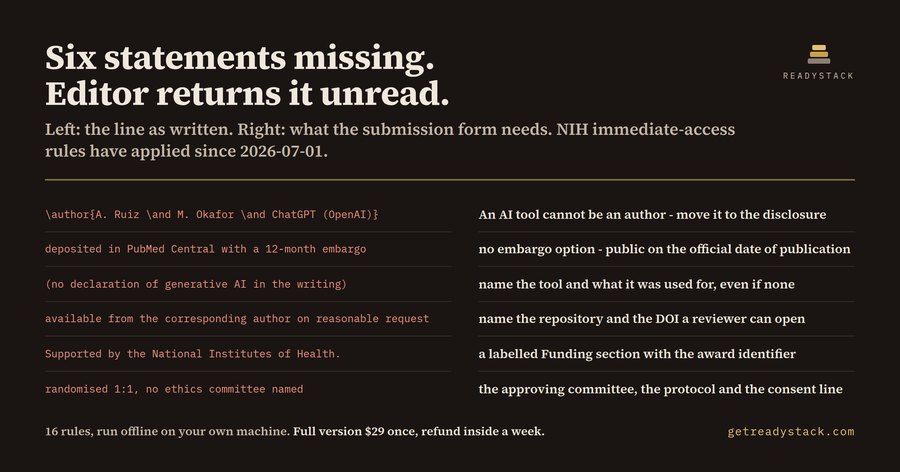
Six required submission statements are missing from this finished manuscript - postdocs and research fellows in UK primary-care groups who submit to ICMJE journals.
== _fixtures/dirty.tex - 14 findings (9 errors) ERROR L1 ai_disclosure_missing No AI-use disclosure: name the tool and what it was used for. ERROR L6 ai_listed_as_author A generative-AI tool sits on the author line; an AI tool cannot be an author. ERROR L13 ethics_approval_missing Patients, but no ethics committee and no protocol number. ERROR L31 grant_number_missing A funder is named with no award identifier. ERROR L33 nih_embargo_stale A 12-month embargo is promised; that option ended on 2026-07-01. ERROR L35 data_locator_missing The data availability statement has no repository, accession or DOI.
Those six errors are what an editorial office bounces a paper for, and the research fellow who wrote the file would have heard about them from an editorial assistant rather than from a reviewer.
The paper was real work: 412 adult asthma patients, six practices, a clean primary endpoint. The submission form was going to ask its file questions the file could not answer. Manuscript Disclosure Lint applies 16 rules to the .tex or .md open in your editor; on this sample manuscript it returns 14 findings, 9 of them errors, each pinned to a line with the wording to paste.
Line 6 read \author{A. Ruiz \and M. Okafor \and ChatGPT (OpenAI)}. Under the ICMJE Recommendations a generative-AI tool cannot be an author: it cannot take responsibility or declare an interest. It belongs in a disclosure paragraph, and that paragraph was absent too, which is the finding on line 1.
Line 33 promised that the accepted manuscript would go to PubMed Central with a 12-month embargo. That sentence describes a policy that no longer exists. The 2024 NIH Public Access Policy applies to papers accepted for publication on or after 2026-07-01: the Author Accepted Manuscript is deposited in PubMed Central and made public on the official date of publication, with no embargo option at all. This is the rule a chatbot gets wrong, because models trained before mid-2026 learned the old window and will write it into your cover letter.
Line 35 said the datasets were available from the corresponding author on reasonable request. Funder open-access conditions and a growing number of journals no longer accept that as the only route, and the statement carried no repository, no accession number and no DOI, so a reviewer had nothing to follow.
Line 31 was the funding: supported by the National Institutes of Health. Publishers index funding as a separate field, and funder reporting systems match on the award identifier, not on the funder name. No award number appeared anywhere in the file. Line 13 is the Methods, where patients were randomised 1:1 with no ethics committee, no protocol number and no consent sentence, which for an ICMJE member journal ends the conversation.
None of that is hard to fix. All of it is easy to forget in a file you have been editing for months, where the science is the part you are actually thinking about. The extension marks each finding on its own line and prints the wording to paste. Nothing is uploaded: an unpublished manuscript under review is confidential, and most institutions and most journals do not permit pasting one into a hosted chat model.
Checking the file open in your editor is free and uncapped: all 16 rules, every finding, the paste-ready lines, with no watermark, no run limit and no locked results. The paid part is a different axis, scope and ownership - sweeping every .tex and .md in a workspace at once and writing a dated report file you keep, for a whole thesis or a lab's back catalogue.
15 seconds — what it actually does
Questions people ask
What does Manuscript Disclosure Lint actually do?
It reads the .tex or .md manuscript open in VS Code and applies 16 rules for the statements journals collect at submission: generative-AI disclosure, data availability with a real locator, funding and award ID, competing interests, CRediT author contributions, ethics approval, informed consent, trial registration, ORCID and an open-access licence. Each finding names the line and the wording to paste.
Who is it for?
Researchers and postdocs who draft papers in LaTeX or Markdown inside VS Code, clinical trialists who must show a registration identifier, and research-office or lab staff who sign off submissions. If you write in Word and submit through a publisher portal that fills these fields for you, you do not need it.
Why not just ask a chatbot?
Two reasons. An unpublished manuscript under review is confidential, and most institutions and journals forbid pasting it into a hosted model. And chatbots are stale here: models trained before mid-2026 still describe the retired 12-month NIH embargo rather than the policy in force since 2026-07-01. This runs offline and carries that date as a rule.
What is free and what costs money?
Checking the file open in your editor is free and uncapped: all 16 rules, every finding, the paste-ready wording, forever. The paid part is scope and ownership — sweeping every manuscript in a workspace at once and writing a dated report file you keep. $29 once, one key per person or CI seat.
What would this cost otherwise?
Commercial manuscript formatting and submission-compliance services are priced at $150-$400 per paper. A desk rejection costs no money but roughly 2 to 6 weeks before the paper reaches a reviewer at the next journal, and the resubmission starts the queue again.
Why not just ask ChatGPT or another AI chat?
A general AI chat answers from training data with a cutoff date, cannot read your repository and names no rule version. Manuscript Lint - journal disclosure statements (COI, fundin checks the file you open against 16 rules from a rule set dated 2026-09-20, and points at the exact line with the fix. For a filing, an audit or a client you need that dated result on your own files.
Ask about this tool
One question, answered by the person who built it. Your email only if you want the answer sent.