· ReadyStack
Worked example
Real numbers from this tool, line by line.
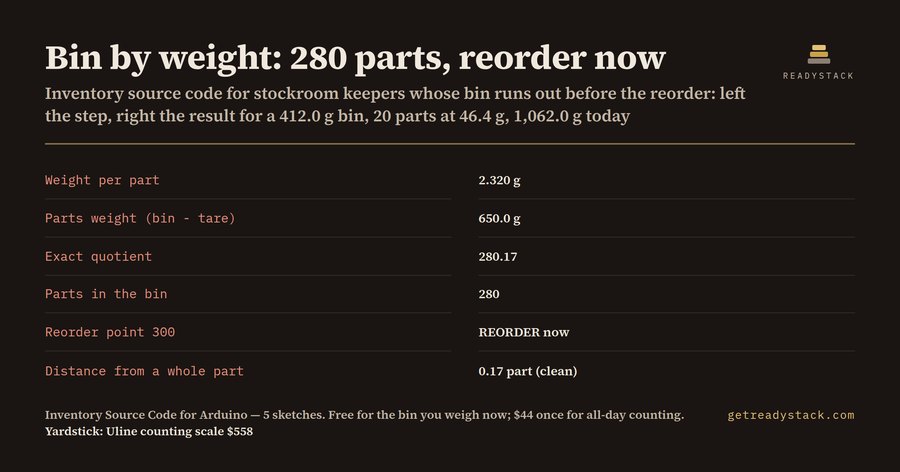
For stockroom keepers with parts in bins: a 412.0 g bin that weighs 1,062.0 g today holds 280 parts, and at a reorder point of 300 that means reorder now. Here is the count, step by step, from 20 sample parts that weigh 46.4 g:
| Step | Value |
|---|---|
| Weight per part (46.4 g / 20) | 2.320 g |
| Parts weight (1,062.0 g - 412.0 g) | 650.0 g |
| Exact quotient (650.0 / 2.320) | 280.17 |
| Parts in the bin | 280 |
| Distance from a whole part | 0.17 part, a clean count |
| Reorder point 300 | REORDER now |
Weigh one part on its own on a 1 g kitchen scale instead and it reads 2 g. 650 / 2 = 325 parts. That is 45 parts too many, and it sits above the reorder point of 300, so the reorder never fires. A 20-part sample on the same bin gives 280.
Why a count, not a weight
Every free load-cell tutorial ends at "print grams". A stockroom needs a whole number of parts and a yes or no for reordering. Three things decide whether that number can be trusted:
- The sample. The per-part value comes from many parts, not one. ScaleCalibration rejects a sample whose raw reading is below MIN_SAMPLE_RAW and tells you to add more parts.
- Stillness. BinScaleCounter only accepts a reading after the weight has stayed within STABLE_BAND_RAW for STABLE_MS (1,500 ms by default). On our host simulation, a weight jumping every 300 ms, like a hand in the bin, produced no count at all.
- Whole parts. If the weight sits more than 0.35 part away from a whole count, the sketch prints AMBIGUOUS and keeps the last good count. 280.5 parts' worth of weight printed "AMBIGUOUS: 49% off a whole part".
The alarm uses hysteresis: it switches on at REORDER_AT (300) and clears only at REARM_AT (330). In the simulation, a partial refill to 310 left the LED on, and a refill to 400 cleared it. The ACK button silences the buzzer, but the LED stays on until the bin is refilled.
No library, no calibration weight
The HX711 is read with digitalRead and digitalWrite, so there is nothing to install from the Library Manager. If the HX711 is dead or miswired, the sketch reports a fault instead of reading zero. Calibration uses your own parts, not a reference weight: send t with the empty bin, put 20 parts in, send s, and paste the two printed const lines.
The other four jobs in the pack
- BreakBeamInOut: two IR beams at a chute. Beam A then B counts IN, B then A counts OUT. A hand that reaches in and pulls back counts nothing, a beam blocked longer than 3,000 ms pauses counting, and OUT is refused at zero.
- TwoBinKanban: a microswitch under the front bin at 4 locations. A bin gone for 2,000 ms latches that location's reorder LED. A quick lift to grab a part is ignored.
- StockLedgerEEPROM: +1/-1 buttons or IN 25 / OUT 3 / SET 120 from a PC. In the simulation, OUT 500 on a stock of 117 was REJECTED, and the count of 137 came back after a simulated power cut.
- ScaleCalibration: the tare and per-part values for your parts.
All 5 sketches compile for the Arduino Uno with arduino-cli: from 2,910 bytes (TwoBinKanban) to 4,010 bytes (StockLedgerEEPROM) of 32,256.
Try your own bin first
The page counts any bin from three weights off any scale, and shows whether your reorder point is reached. The sketches that do it all day at the shelf are the paid part. For scale: Uline lists its Industrial Counting Scale H-1114 at $558 each for one bench.
15 seconds — what it actually does
Questions people ask
What does this inventory source code for Arduino actually do?
Five Arduino Uno sketches count stock without a PC: BinScaleCounter counts parts in a bin by weight and raises a reorder alarm, BreakBeamInOut counts items in and out through a chute, TwoBinKanban lights a reorder LED for 4 bin locations, StockLedgerEEPROM keeps a count that survives power cuts, and ScaleCalibration sets the scale up from your own parts.
Who is this Arduino inventory pack for?
Makerspace, repair-shop and small-assembly stockroom keepers who keep screws, connectors or spare parts in bins and already own an Arduino Uno plus an HX711 load-cell board, IR break beams or microswitches. You want a reorder light at the shelf, not another spreadsheet that nobody updates.
Why not use a free Arduino load-cell tutorial?
Free load-cell tutorials need the HX711 library and a calibration weight, and they print grams. None of them counts whole parts, refuses to count while a hand is in the bin, flags a weight that sits between two counts, or holds a reorder alarm with hysteresis so it does not flicker at the threshold. These sketches do all four with the core API only.
What can I do free on the page?
Type your empty-bin weight, the weight of a sample of your parts and today's bin weight from any kitchen or postal scale. Example: 412.0 g bin, 20 parts weighing 46.4 g, 1,062.0 g today gives 280 parts, a clean count, and REORDER at a 300 reorder point. A 1-part sample on a 1 g scale would read 325. The sketches that do this all day are the paid part.
How does the price compare with a ready-made counting scale?
Uline lists its Industrial Counting Scale H-1114 (6 lb x .0005 lb) at $558 each on uline.com, checked 2026-10-18, for one bench. This pack is $44 once and runs on an Arduino Uno and HX711 board you already own. It adds a reorder alarm, a two-beam in/out counter, a 4-location kanban light and a power-cut-safe ledger.
Ask about this tool
One question, answered by the person who built it. Your email only if you want the answer sent.