· ReadyStack
Worked example
Real numbers from this tool, line by line.
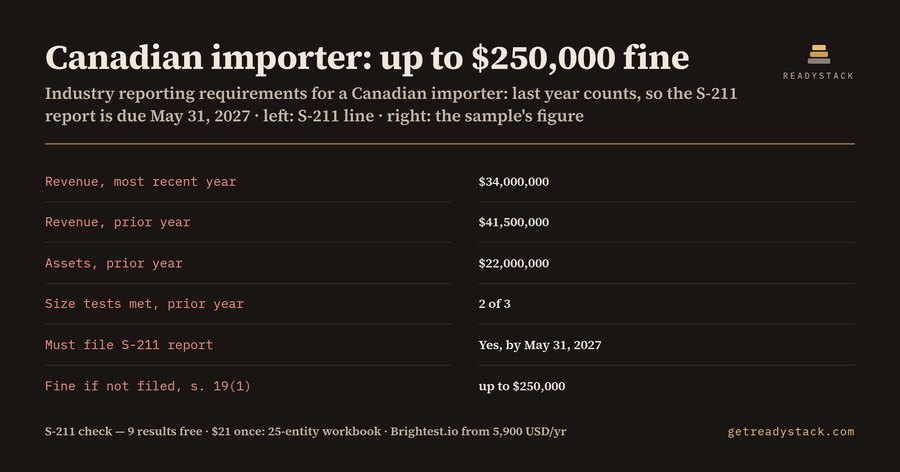
A Canadian importer with $34,000,000 in revenue this year still faces up to $250,000 in fines if it skips the S-211 report, because last year it had $41,500,000 in revenue and $22,000,000 in assets. Here is that result as the free check computes it:
| Line | Most recent year | Prior year |
|---|---|---|
| Assets | $26,000,000 | $22,000,000 |
| Revenue | $34,000,000 | $41,500,000 |
| Average employees | 180 | 150 |
| Size tests met | 1 of 3 | 2 of 3 |
Result: reporting entity, must file by May 31, 2027, fine at stake up to $250,000 (s. 19(1)).
Why the latest year is not enough
The Fighting Against Forced Labour and Child Labour in Supply Chains Act (S.C. 2023, c. 9) defines an entity as a corporation, trust or partnership listed on a stock exchange in Canada, or one with a place of business, business or assets in Canada that meets at least two of three conditions for at least one of its two most recent financial years: at least $20 million in assets, at least $40 million in revenue, an average of at least 250 employees.
The phrase "at least one of its two most recent financial years" is the trap. A controller who looks only at this year's statements sees one test met and stops. The Act looks back one more year. In the example, the prior year alone carries the company over the line.
Who has to file
Being an entity is not the whole test. Section 9 applies the reporting duty to entities that produce, sell or distribute goods, import goods into Canada, or control an entity that does. A pure service company is outside it; a holding company that controls an importer is inside it.
The report is due on or before May 31 of each year and covers the previous financial year (s. 11(1)). It goes to Public Safety Canada through an online questionnaire with the report attached as a PDF, and it must be published in a prominent place on your website (s. 13(1)).
What the report must contain
Section 11(3) lists seven items, (a) to (g): structure, activities and supply chains; policies and due diligence; risk areas and the steps taken; remediation of forced or child labour; remediation of lost family income; employee training; and how you assess effectiveness. The governing body must approve it (s. 11(4)), and the approval needs a statement of the route used plus at least one member's signature (s. 11(5)).
What it costs to miss
Failing to file is an offence punishable on summary conviction with a fine of not more than $250,000 (s. 19(1)). Any director or officer who directed, authorized or acquiesced in the failure is a party to the offence (s. 20).
Try it with your own numbers
The free check asks for six figures from your two most recent consolidated statements, your Canada link and whether you deal in goods. It returns 9 results, including how far you sit from each threshold, so you can also see whether next year is close.
Running a group? The $21 workbook applies the same two-year test to up to 25 entities and counts how many must file. Its 14-item tracker covers the s. 11(3) contents, approval, attestation, upload and publication.
15 seconds — what it actually does
Questions people ask
What does this industry reporting requirements check tell me?
It runs the S-211 entity test on your own figures: how many of the three size tests (at least $20 million in assets, $40 million in revenue, an average of 250 employees) you meet in each of your two most recent financial years, whether that makes you a reporting entity, and whether you must file by May 31, 2027.
Who is this for?
Controllers, CFOs and compliance leads of companies that produce, sell, distribute or import goods and have a place of business, do business or hold assets in Canada, or are listed on a Canadian stock exchange. Listed companies are entities whatever their size; everyone else depends on the two-of-three size test.
Why not just read a summary or ask a chatbot?
Most summaries test only the latest year. S-211 counts an entity that meets at least two of the three conditions for at least one of its two most recent financial years. Example: 2026 revenue $34,000,000 but 2025 revenue $41,500,000 with $22,000,000 in assets still means you must file by May 31, 2027. Failing to file is an offence with a fine of not more than $250,000 (S-211 s. 19(1)).
What is free and what costs money?
The full check for one entity is free in the browser, with all 9 results and no sign-up. The $21 .xlsx workbook, one payment and no subscription, runs the same test for up to 25 group entities and tracks the s. 11(3) report items (a) to (g), board approval, attestation, upload and website publication.
What does the alternative cost?
Brightest.io lists its ESG Impact plan at "Starts at $5,900 per year, billed annually" (pricing page read 2026-10-18); Mitratech and Prevalent quote S-211 supplier-risk platforms on request. Not filing risks a fine of not more than $250,000 per offence (S-211 s. 19(1)), and directors who acquiesced are parties to the offence (s. 20). The workbook is $21 once.
When could these rules change?
The Act came into force on January 1, 2024. Section 25(1) requires a comprehensive parliamentary review at the start of the fifth year after that, which is January 2028, and the committee must report recommended changes within one year. Until then the May 31 deadline repeats every year: the next one is May 31, 2027.
Ask about this tool
One question, answered by the person who built it. Your email only if you want the answer sent.