· ReadyStack
Worked example
Real numbers from this tool, line by line.
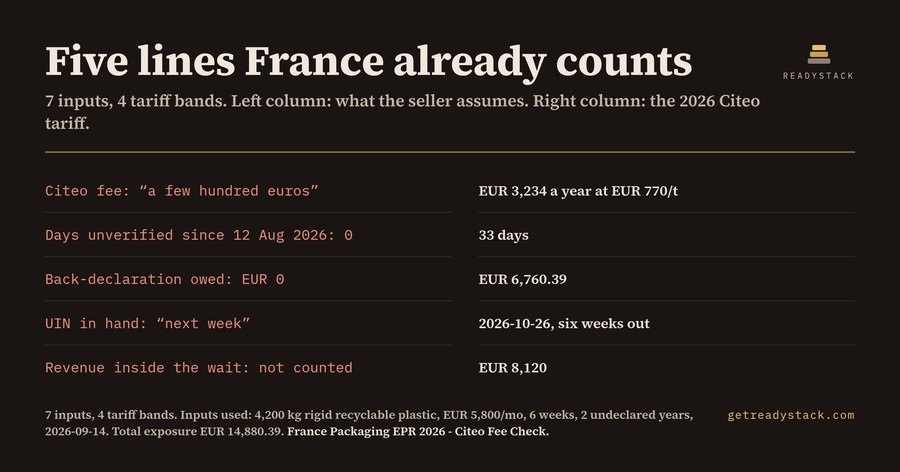
EUR 14,880.39 of packaging-EPR exposure is already running against a single product line - Etsy and Amazon.fr sellers shipping into France, 33 days past Article 45 verification.
That is the finished run for 4,200 kg of rigid recyclable plastic, EUR 5,800 a month of French revenue, a six-week register lead time, two undeclared years, dated 2026-09-14:
- 2026 Citeo fee for this packaging: EUR 3,234 a year
- Eco-modulation bonus or penalty: EUR 0
- Days sellable-but-unverified since 12 Aug 2026: 33
- Back-declaration you already owe: EUR 6,760.39
- Earliest date your UIN can exist: 2026-10-26
- French revenue inside the waiting window: EUR 8,120
- Total exposure today: EUR 14,880.39
Seven figures, and only the first one is the fee.
Citeo, the producer responsibility organisation for French household packaging, republishes a tariff every year. For 2026 the household levels are EUR 20 a tonne for glass, EUR 258 for paper and cardboard, EUR 770 for rigid recyclable plastic, and EUR 1,400 for rigid plastic that is hard to recycle. 4,200 kg is 4.2 tonnes, so at EUR 770 the yearly fee is EUR 3,234. The trouble starts one line further down.
Registration is not forward-looking: register late and you declare what you already placed on the market. Two full years of undeclared selling plus the days accrued since 12 August 2026 turn EUR 3,234 a year into EUR 6,760.39 owed on the day you finally sign up. The fee did not grow. The bill did, because it was always accruing and nobody invoiced it.
12 August 2026 is the date that changed the mood. That is when PPWR Article 45 marketplace verification began: online platforms have to check producer registration before letting a listing trade. So the count of days since 12 August is not a compliance curiosity. It is the number of days your listing has been live and suspendable at the platform's convenience.
Then there is the waiting. Registers are quoting two to eight weeks. At six weeks, a seller starting on 2026-09-14 has a unique identification number on 2026-10-26 at the earliest, and EUR 5,800 a month of French revenue means EUR 8,120 sits inside that window. Add the back-declaration and you get EUR 14,880.39.
Change one input and the shape of the problem changes. A seller moving 9,000 kg of non-recyclable multi-layer plastic pays EUR 18,900 for the year, because the 2026 schedule adds a penalty on top of the EUR 1,400 tariff - EUR 6,300 of penalty in that case. Three undeclared years and a November date push back-declaration to EUR 60,997.81 and total exposure to EUR 87,504.47. Meanwhile a small paper-and-cardboard shop at 1,600 kg with no undeclared years owes EUR 37.32 in back-declaration and EUR 412.80 for the year. Same law, same tool, two orders of magnitude apart.
That spread is why a general chatbot is a bad place to ask. Citeo republishes the tariff and its eco-modulation bonus and penalty annually, and a model answers with whichever year it absorbed, usually without naming it. Nor will it count days against 12 August 2026 for your date, or catch that the bonus for mono-material recyclable PET with recycled content applies to plastics only - worth EUR 485.10 off the same 4,200 kg.
France Packaging EPR 2026 is a browser extension and a free web page running that same calculation: pick the material, type the weight, your French monthly revenue, the quoted lead time and your undeclared years. The table above comes back with the tariff band it used, so you can check it against your own Citeo paperwork.
All of that is free and unlimited - every tariff band, both eco-modulation directions, the day count, the back-declaration, the revenue at risk. Nothing blurs, nothing locks after N runs. The USD 60 key adds .csv export of the lines you priced and alarms for the next declaration window. Seller-service firms quote roughly EUR 150 to EUR 1,000 per country per year just to hold one registration and file for it.
Questions people ask
What does this extension actually work out?
It prices one year of your French household packaging against the 2026 Citeo tariff table - glass EUR 20 a tonne, paper and cardboard EUR 258, rigid recyclable plastic EUR 770, rigid hard-to-recycle plastic EUR 1,400 - applies the eco-modulation bonus or penalty, then counts the days since Article 45 verification began on 12 August 2026 and turns them into a back-declaration figure and a waiting-window revenue risk.
Who is it for?
Sellers based outside France who ship packaged goods to French households through Etsy, Amazon.fr, eBay or their own Shopify store, and who have no Citeo unique identification number yet. It is built for the person who found out about packaging EPR from a marketplace compliance email rather than from a lawyer, and who needs a euro figure this afternoon.
Why can a free chatbot not do this?
Citeo republishes its tariff and its eco-modulation bonus and penalty every year, and a general model answers with whichever year it absorbed, usually without saying which. It also cannot count days against 12 August 2026 for you. This tool holds the 2026 figures, shows the tariff it used, and recomputes the day count from the date you type.
What is free and what needs the key?
Every calculation is free and unlimited: all four tariff bands, both eco-modulation directions, the Article 45 day count, the back-declaration estimate and the revenue at risk. Nothing is blurred and nothing locks after N runs. The $60 key adds .csv export of your priced lines and renewal alarms for the next declaration window.
What would paying someone else cost?
Seller-service firms quote roughly EUR 150 to EUR 1,000 per country per year simply to hold one packaging EPR registration and file its declarations, and that is before the fee itself. A one-off $60 key sits under the cheapest month of that, and the calculation underneath it stays free whether you buy or not.
Ask about this tool
One question, answered by the person who built it. Your email only if you want the answer sent.