· ReadyStack
Worked example
Real numbers from this tool, line by line.
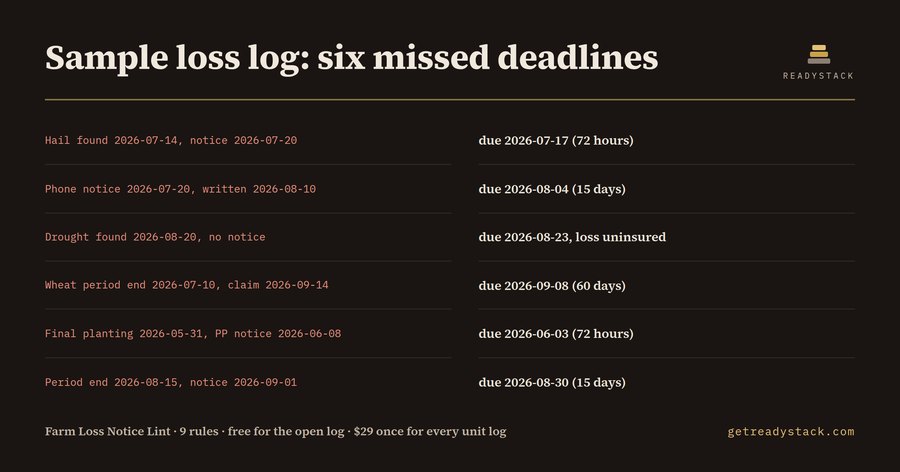
Six missed deadlines turned up in a sample crop insurance loss log for a US farm, crop year 2026, and every one of them is a date that 7 CFR 457.8 section 14 sets for crop insurance agents and farm offices.
The sample log belongs to a made-up operation, Miller Farms, with five units: corn with hail, soybeans with drought, wheat with excess rain, corn that could not be planted, and grain sorghum with wind damage. Each unit has a heading and a few lines of dates: when the damage was found, when the agent was called, how the notice was given, when the insurance period ended, when the claim went in.
Checked on 2026-09-28, the log produced these six findings:
- Corn, hail: damage found 2026-07-14, notice 2026-07-20. Notice was due by 2026-07-17, within 72 hours of discovery (section 14(b)(1)).
- Corn, hail: the notice was given by phone on 2026-07-20 and confirmed in writing on 2026-08-10. Written confirmation was due by 2026-08-04, within 15 days (section 14(b)(4)).
- Soybeans, drought: damage found 2026-08-20, no notice recorded. Notice was overdue from 2026-08-23.
- Wheat, excess rain: insurance period ended 2026-07-10, claim submitted 2026-09-14. The claim was due by 2026-09-08, 60 days after the period ended (section 14(e)(3)).
- Corn, prevented planting: final planting date 2026-05-31, prevented planting notice 2026-06-08. With no late planting, notice was due by 2026-06-03, within 72 hours (section 14(b)(3)).
- Grain sorghum, wind: insurance period ended 2026-08-15, notice 2026-09-01. Notice was due by 2026-08-30, no later than 15 days after the period ended (section 14(b)(1)).
Why the dates matter
Section 14(b)(5) is short: if you fail to submit a notice of loss in accordance with the notice provisions, any loss is considered solely due to an uninsured cause of loss for that acreage. For a claim for indemnity, no indemnity will be paid, but you will still be required to pay all premiums owed. The damage can be real and fully documented and still not be paid because a date slipped.
The end of the insurance period is an input, not a constant. It differs by crop, by county and by what happened on the unit, so the log records it per unit. The claim rule counts 60 days from that date. For revenue protection the claim date is the later of 60 days after the harvest price is released and 60 days after the period ends, so a revenue protection unit without a harvest price release date gets a warning instead of a guess.
What changes with the check date
Run the same log on 2026-10-20 and a seventh finding appears: the sorghum unit's insurance period ended 2026-08-15, so its claim was due by 2026-10-14. On 2026-09-28 that date had not passed, so the lint stayed quiet. The rules only speak when a date has actually been missed.
What a free alternative misses
A chatbot or a date calculator can add 72 hours to one date. It does not read the log, so it does not notice that a phone notice needs written confirmation within 15 days, or that a unit found damaged 12 days before harvest must leave representative samples intact under section 14(c)(1). The lint runs all 9 rules on every unit each time the file is saved.
How to try it
Paste a loss log into the web version or open it in VS Code. Every rule runs free on the open file, with the due date next to each finding. The full version scans every unit log in a workspace at once and exports a CSV deadline report per unit. The tool reads dates; it does not replace your agent or the Crop Provisions for your crop.
15 seconds — what it actually does
Questions people ask
What does Farm Loss Notice Lint check?
It reads a crop insurance loss log written in Markdown, one heading per unit, and checks each date against 7 CFR 457.8 section 14: notice within 72 hours of discovering damage, no later than 15 days after the insurance period ends, written confirmation of a phone notice within 15 days, prevented planting notice within 72 hours, and the 60-day claim. Each finding shows the date that was due.
Who is it for?
It is for US crop insurance agents, farm office managers and ag-tech developers who track losses per unit in Markdown files, in a git repository or a notes folder. If you log when hail, drought or excess rain was found and when the agent was called, the lint tells you which unit missed a notice or claim date and by how many days.
Why not just ask a chatbot or use a date calculator?
A chatbot or a date calculator answers one question at a time and does not read your loss log. It will not notice that a phone notice was never confirmed in writing within 15 days, or that a claim date for revenue protection depends on the harvest price release. The lint checks every unit in the file on every save.
What is free and what does the full version add?
Free, with no key: all 9 rules on the loss log open in VS Code or pasted into the web version, with the due date for every finding. The full version, $29 once for one licence key per person or team seat, scans every unit log in the workspace at once and exports a CSV deadline report per unit for the agency file.
What does a missed deadline cost?
Under 7 CFR 457.8 section 14(b)(5), if you fail to submit a notice of loss, the loss is considered solely due to an uninsured cause: no indemnity is paid and premiums are still owed. Checking the dates by hand for every unit takes time each season; the lint does it whenever the file is saved.
Why not just ask ChatGPT or another AI chat?
A general AI chat answers from training data with a cutoff date, cannot read your repository and names no rule version. Farm Loss Notice Lint: Crop Insurance Deadlines checks the file you open against 9 rules, each naming its legal or official basis, from a rule set dated 2026-09-28, and points at the exact line with the fix. For a filing, an audit or a client you need that dated result on your own files.
Ask about this tool
One question, answered by the person who built it. Your email only if you want the answer sent.