· ReadyStack
Worked example
Real numbers from this tool, line by line.
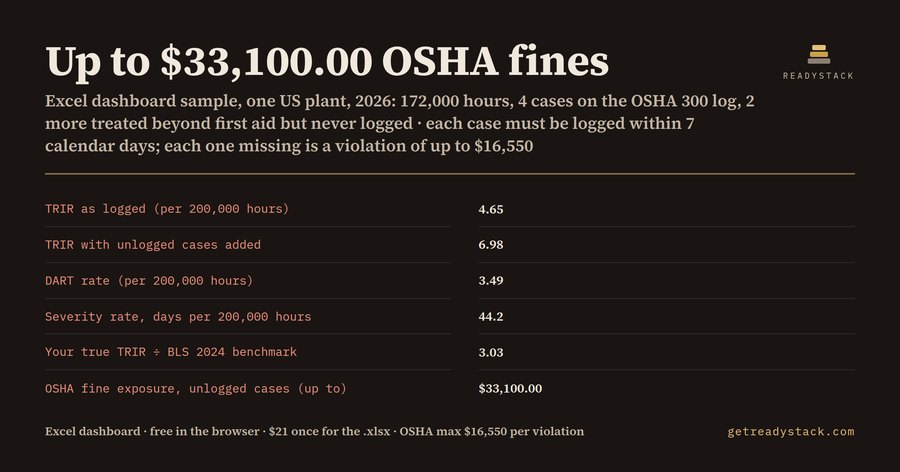
Up to $33,100.00 in OSHA fines sits behind a TRIR of 4.65 at one US plant, because its safety manager left 2 cases treated beyond first aid off the OSHA 300 log. Put those 2 cases back and the true TRIR for 2026 is 6.98, which is 3.03 times the BLS 2024 private-industry rate of 2.3.
| Safety KPI dashboard, sample plant, 2026 | Value |
|---|---|
| Hours actually worked | 172,000 |
| Recordable cases on the OSHA 300 log | 4 |
| Days-away or restricted/transfer cases | 3 |
| Days-away-from-work cases | 1 |
| Days counted (max 180 per case) | 38 |
| Cases treated beyond first aid, not logged | 2 |
| TRIR as logged | 4.65 |
| TRIR with unlogged cases added | 6.98 |
| TRIR understated by | 2.33 |
| DART rate | 3.49 |
| LTIR | 1.16 |
| Severity rate | 44.2 |
| True TRIR ÷ BLS 2024 benchmark (2.3) | 3.03 |
| Cases these hours allow at the benchmark | 1.98 |
| OSHA fine exposure, unlogged cases (up to) | $33,100.00 |
How the numbers come out
Every OSHA incidence rate uses the same base: cases × 200,000 ÷ hours actually worked. The 200,000 stands for 100 full-time workers at 40 hours a week for 50 weeks, so the rate reads as cases per 100 full-time workers. Here: 4 × 200,000 ÷ 172,000 = 4.65. With the 2 unlogged cases, 6 × 200,000 ÷ 172,000 = 6.98.
DART counts only the cases with days away, restricted work or a job transfer: 3 × 200,000 ÷ 172,000 = 3.49. LTIR counts the days-away cases alone: 1.16. The severity rate puts the days counted on the same base: 38 × 200,000 ÷ 172,000 = 44.2. Days stop counting at 180 per case (29 CFR 1904.7(b)(3)(vii)), so enter the capped total.
Why the unlogged cases matter
A case is recordable when it needs medical treatment beyond first aid, days away, restricted work, a transfer, causes loss of consciousness, or is a significant diagnosed injury or illness (29 CFR 1904.7). It has to be on the 300 log within 7 calendar days (29 CFR 1904.29(b)(3)). OSHA kept its 2025 penalty levels for 2026: up to $16,550 per serious or other-than-serious violation and up to $165,514 per willful or repeat violation (OSHA memo, May 21, 2026). Two cases left off the log, priced at that maximum, come to $33,100.00. OSHA can reduce a penalty for size, good faith and history, so this is a ceiling, not a bill.
Three plants, three answers
- Sample plant, 2 cases not logged: TRIR 4.65 as logged, 6.98 true, 3.03 times the benchmark, up to $33,100.00.
- Same plant, every case logged: TRIR 4.65 both ways, 2.02 times the benchmark, $0.00 exposure.
- Bigger site, 400,000 hours, 9 cases logged, 1 not: TRIR 4.5 as logged, 5 true, 2.17 times the benchmark, up to $16,550.00.
What is free and what the workbook adds
The web dashboard is free and complete: type your hours and your 300 log counts and every rate, the benchmark ratio and the exposure appear on screen. Nothing is uploaded. The .xlsx workbook is a one-time purchase, not a subscription: the same 9 live formulas in Excel or LibreOffice, one copy per site or per month, ready for a board, insurer or prequalification report.
Replace the 2.3 benchmark with the BLS rate for your own NAICS code. Post your 2026 Form 300A from February 1 to April 30, 2027 (29 CFR 1904.32).
Not legal advice. Rules as of October 2026.
15 seconds — what it actually does
Questions people ask
What does this Excel dashboard calculate?
It turns your OSHA 300 log counts and the hours your people actually worked into TRIR, DART, LTIR and severity rate on the 200,000-hour base OSHA and BLS use. It then adds the cases you treated beyond first aid but left off the log, shows the true TRIR, compares it with the BLS 2024 benchmark of 2.3, and prices the unlogged cases at the 2026 OSHA maximum.
Who is this safety KPI dashboard for?
US EHS and safety managers, plant managers and HR leads who keep an OSHA 300 log under 29 CFR 1904 and must report TRIR and DART to leadership, insurers or customer prequalification portals. It fits any single establishment that knows its hours worked and its logged cases for the year.
Why not use a free TRIR calculator?
Free TRIR calculators divide what you type and stop. They do not ask about cases treated beyond first aid that never reached the 300 log, so they report the flattering rate. This dashboard shows both rates side by side and the fine exposure at the 2026 OSHA maximum of $16,550 per violation.
What is free and what does the paid file add?
The web calculator is free and complete: enter your eight numbers and see every rate, the benchmark comparison and the exposure on screen. The $21 one-time purchase is the .xlsx workbook with the same nine live formulas, which you keep, copy per site or per month, and attach to a board or insurer report.
How does $21 compare with getting the log wrong?
OSHA kept its 2025 penalty levels for 2026: up to $16,550 per serious or other-than-serious violation and up to $165,514 per willful or repeat violation. One unlogged recordable case cited as a recordkeeping violation can cost far more than this one-time workbook, which is not a subscription.
When do these numbers change next?
The Federal Civil Penalties Inflation Adjustment Act requires agencies to adjust maximum penalties by January 15 each year, so the next OSHA penalty figure is due by January 15, 2027. BLS publishes the 2025 injury rates in its annual Survey of Occupational Injuries and Illnesses release, usually in late autumn.
Ask about this tool
One question, answered by the person who built it. Your email only if you want the answer sent.