· ReadyStack
Worked example
Real numbers from this tool, line by line.
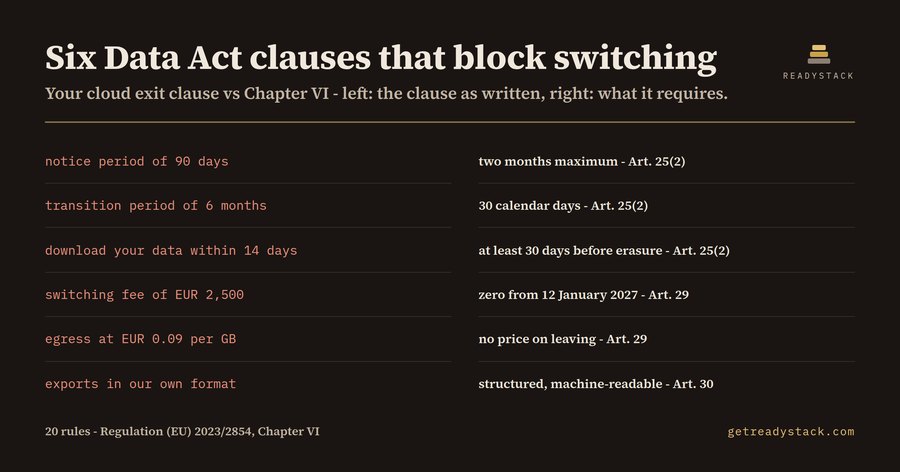
EUR 2,500 to leave, plus EUR 0.09 per GB to take your data out - EU SaaS vendors, platform engineers and in-house counsel: that is the exit clause sitting in your repository, and this is what the checker prints over it.
L5   error  Art. 25(2)  Notice period of 90 days to start switching.
L9   error  Art. 25(2)  Transitional period of 6 months.
L11  error  Art. 29     Egress charge named in an exit clause.
L15  error  Art. 25(2)  Retrieval window of 14 days.
L16  error  Art. 25(2)  Data erased at termination.
L17  error  Art. 30     Export offered only in a proprietary format.
Six lines, six errors, one file: _fixtures/dirty.md, the sample contract bundled with the extension. Run every rule over that file and it returns 21 findings - 14 errors and 7 warnings - from all 20 rules. The corrected version, also bundled, returns 0.
The date behind those lines is 12 September 2025, when Chapter VI of Regulation (EU) 2023/2854 - the Data Act - started to apply to data processing services. A customer may switch to another provider or move to their own on-premises infrastructure. The notice period to start that switch is capped at two months. The mandatory maximum transitional period is 30 calendar days. Exportable data and digital assets come back in a structured, commonly used, machine-readable format. Erasure happens after a retrieval period of at least 30 days, not on the termination date. And the price of leaving falls to nothing: reduced, cost-based charges during the transition window, then zero from 12 January 2027.
Now open the terms file in your own repository - the one written from a 2023 template, or re-drafted by a model trained on templates like it. It says a notice period of 90 days, where the cap is two months. It says a transition period of six months, where the maximum is 30 days. It gives the customer 14 days to download their data and deletes everything immediately afterwards, where the minimum retrieval window is 30 days. It charges a switching fee of EUR 2,500 and bills bulk extraction at EUR 0.09 per GB. It exports in a proprietary format with no published schema. And in the regulatory paragraph, it says the Data Act applies from January 2024 - the entry into force, not the date of application.
Seven of the 20 rules look for absences rather than bad wording, and absences are what a reader misses most reliably. No clause granting the right to switch. No promise of a machine-readable export format. No assistance clause. No published jurisdictions for the infrastructure that stores customer data. No register of the data structures and formats a customer can export. No mention of functional equivalence for infrastructure services. No point of contact for a switching request. You cannot spot a missing paragraph by reading it; you spot it by checking a list.
One rule knows what day it is. Run the charge rule now and it reports that switching charges must be zero from 12 January 2027 - 121 days from 13 September 2026. Run the same text after that date and the warning becomes an error, because the transition window has closed. Same file, same rule, different answer, because the calendar moved.
This is also the specific place where a general-purpose model is unreliable. Ask one about the Data Act and it will often tell you it applied in 2024. The checks here are 20 fixed rules, cited to Art. 23, 25, 26, 29 and 30, run over the actual files.
Free finishes one file: open a contract, run the check, read every finding with its line and its article. The paid tier is a different axis - scope and a keepsake. One sweep over every contract file in the workspace, and a dated report with a per-file table that you own and hand to counsel. An EU technology lawyer reviewing the exit clauses of one cloud contract bills at EUR 250-450 per hour; the point of the report is that the hour is spent on wording, not on finding the clauses.
Questions people ask
What does this actually check?
It reads contract text and applies 20 checks drawn from Chapter VI of Regulation (EU) 2023/2854, the Data Act: notice period to start switching, the 30-day transitional period, the retrieval window before erasure, egress and switching charges, export format, and the transparency facts a provider must publish. Each finding names the article and the line.
Who is it for?
EU cloud, hosting and SaaS vendors who keep terms of service, master service agreements and DPAs as files in a repository. Typically the founder or platform engineer who edits those files, and the in-house counsel who reviews the diff. It is also useful to a buyer reading a supplier's exit clauses before signing.
Why not just ask a chatbot?
A general model will re-draft a clause happily, but it guesses dates: it commonly says the Data Act applied in 2024 rather than 12 September 2025, and it does not know which of your files contain contract text. This runs the same 20 checks over every file, offline, and cites the article for each finding.
What is free and what is paid?
Free finishes one file: open a contract, run the check, and you get every finding in that file with its article and replacement wording, in the editor or in the browser page. Paid adds scope and a keepsake: one sweep across the whole workspace and a dated report file you own and can hand to counsel.
What would this cost otherwise?
An EU technology lawyer reviewing the exit clauses of one cloud contract bills at EUR 250-450 per hour, and a vendor usually has more than one contract template. This is a one-off 29 dollars for the workspace sweep and the dated report, so counsel spends the hour on the wording rather than on finding the clauses.
Why not just ask ChatGPT or another AI chat?
A general AI chat answers from training data with a cutoff date, cannot read your repository and names no rule version. EU Data Act Switching Clause Lint checks the file you open against 20 rules, each naming its legal or official basis, from a rule set dated 2026-09-20, and points at the exact line. For a filing, an audit or a client you need that dated result on your own files.
Ask about this tool
One question, answered by the person who built it. Your email only if you want the answer sent.