· ReadyStack
Worked example
Real numbers from this tool, line by line.
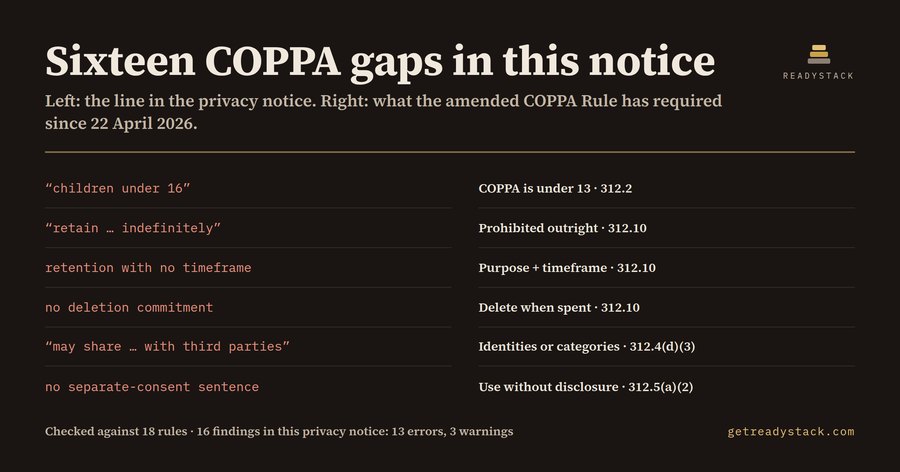
Sixteen findings came back from the sample kids' privacy notice shipped with this extension - the notice a US indie game or edtech developer gets when they ask a chatbot for one. Eighteen checks, one file of 36 lines, 13 errors and 3 warnings.
The amended Children's Online Privacy Protection Rule took effect in June 2025 and required full compliance from 22 April 2026. That date has passed. What changed is not the spirit of COPPA - it is the list of sentences that must appear in the online notice, and a model trained on a decade of pre-amendment policies does not write them.
It says "children under 16". COPPA's threshold is under 13; 16 is the GDPR age of consent. A notice built around 16 is a European notice wearing an American title (312.2).
It says "We may share information with third parties, including our partners and service providers". The amended Rule closed that shortcut: the notice must give the identities of the third parties, or their categories together with the purposes of the disclosure (312.4(d)(3)).
It says "We retain your child's information indefinitely so that progress is never lost". Indefinite retention of children's data is now prohibited outright; 312.10 asks for a written retention policy in the notice itself, with a purpose, a timeframe and a deletion commitment - "18 months after the last sign-in, crash logs 90 days" is the shape that passes.
It says parents can "review or delete". The Rule names three rights, not two: review, delete, and refuse any further collection, each with its procedure (312.4(d)(4)). It offers a support e-mail and nothing else, where 312.4(d)(1) lists three contact items - e-mail, postal address, telephone.
It never says that a parent may consent to collection and use without also consenting to disclosure to third parties. That separate-consent sentence is the single most common gap in notices written before 2026 (312.5(a)(2)).
It quotes the wrong deadline - "The compliance deadline for the amended COPPA Rule is June 23, 2025". June 2025 was the effective date; full compliance was 22 April 2026. And it is dated March 3, 2024, which settles it: a notice revised two years before the amendments cannot contain the clauses they added.
The other checks cover operators, passive collection, persistent identifiers tied to support for the internal operations, the no-conditioning statement of 312.7, and - where a classroom appears - the school-authorisation limits added at 312.5(c)(10).
The second file shipped with the extension is the same notice rewritten: 0 findings against the same 18 checks. The difference is about forty sentences of plain English, which is the point - this is not a document that needs redrafting from scratch, it is a document with sixteen holes in it, and holes are findable by machine.
The check needs two things: the text and the date. A notice revised before 22 April 2026 fails outright, and one more than 365 days old is flagged as overdue - the clean sample passes on 14 September 2026 and picks up one warning if you ask again on 1 October 2027. Nothing leaves the machine.
Checking the notice open in the editor is free, no key and no account, and the same 18 clauses run in the browser on the tool page. The paid part is a different job: sweeping every notice, translation and doc page in a workspace into a dated report file you keep. For scale, outside privacy counsel reviewing one children's notice bills 6 to 10 hours at $350 to $550 an hour. The lint does not replace that review; it empties the mechanical half of it first.
15 seconds — what it actually does
Questions people ask
What does COPPA 2026 Notice Lint actually do?
It reads a children's privacy notice - PRIVACY.md, a docs page, or a served HTML file - and checks it against 18 clauses of the amended COPPA Rule that became fully enforceable on 22 April 2026. Each finding names the line and the section of 16 CFR Part 312 behind it, so you edit the sentence rather than rewrite the document.
Who is it for?
Developers and solo publishers who ship apps, games or edtech to children under 13 in the United States and keep the privacy notice in the repository. It is written for the person who has no privacy counsel on retainer and who is the one who will be asked, by an app store reviewer or by a school district, to prove the notice is current.
Why will a chatbot or a free policy generator not do this?
Both were trained on notices written before the 2025 amendments. They produce the 2013 shape: a retention sentence with no timeframe, no separate consent for third-party disclosure, no list of operators, and often the GDPR threshold of 16 rather than COPPA's 13. On the sample notice shipped here that pattern returns 16 findings.
What is free and what costs money?
Checking the notice open in your editor against all 18 clauses is free, with no key and no account, as is the same check in the browser. The paid part is a different job: sweeping every notice, translation and doc page in the workspace and writing a dated report file you keep. That is $29 once, one key per person or CI seat.
What would this cost if a person did it?
Outside privacy counsel reviewing one children's notice against the amended Rule bills roughly 6 to 10 hours at $350 to $550 an hour. The lint does not replace that review; it removes the mechanical gaps first, so the hours that are billed are spent on judgement rather than on finding a missing retention timeframe.
Why not just ask ChatGPT or another AI chat?
A general AI chat answers from training data with a cutoff date, cannot read your repository and names no rule version. COPPA 2026 Notice Lint checks the file you open against 18 rules, each naming its legal or official basis, from a rule set dated 2026-09-20, and points at the exact line. For a filing, an audit or a client you need that dated result on your own files.
Ask about this tool
One question, answered by the person who built it. Your email only if you want the answer sent.