· ReadyStack
Worked example
Real numbers from this tool, line by line.
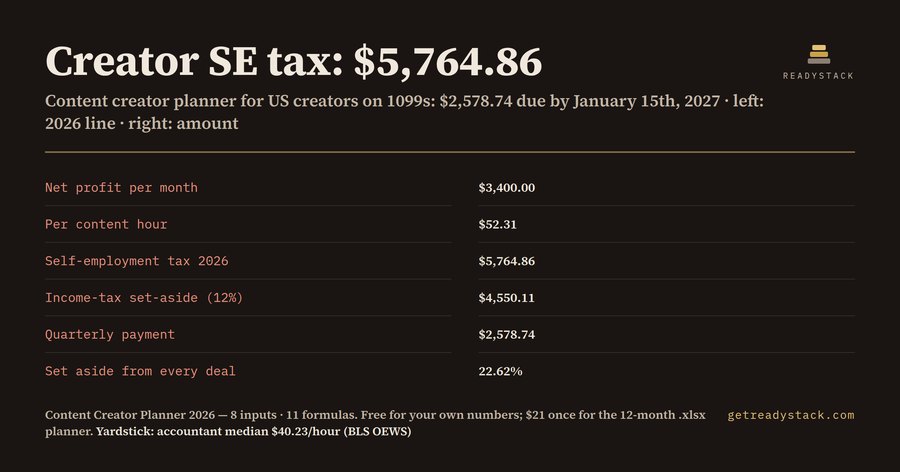
A US content creator paid on 1099s who nets $3,400.00 a month owes $5,764.86 in self-employment tax for 2026, before a single dollar of income tax. That is the first line this content creator planner prints for a typical mid-size creator: five posts a week at three hours each, two brand deals at $1,500, $800 from ads and affiliate links, and $400 of gear and software.
| Result | Value |
|---|---|
| Content hours per month | 65.0 |
| Net profit per month | $3,400.00 |
| What you earn per content hour | $52.31 |
| Self-employment tax 2026 | $5,764.86 |
| Income-tax set-aside at 12% | $4,550.11 |
| Quarterly estimated payment | $2,578.74 |
| Share of every payment to set aside | 22.62% |
| Take-home per month after set-aside | $2,540.42 |
Why the number is that big
Brands, ad programs and affiliate networks do not withhold tax. The IRS Form 1040-ES for 2026 spells out the self-employment tax worksheet: take 92.35% of your net profit, charge 12.4% on that amount up to the social security maximum of $184,500, and 2.9% Medicare on all of it. If you expect to owe at least $1,000 for 2026, you are expected to pay in four installments: April 15, June 15, September 15, 2026, and January 15, 2027. Miss them and Form 2210 adds an underpayment penalty on top.
Three creators, three different answers
A part-time creator posting three times a week at two hours, with one $800 deal and $300 of other income, nets $950.00 a month. Self-employment tax: $1,610.77 for the year, $720.53 a quarter.
The mid-size creator above sets aside $10,314.97 for the year, 22.62% of every payment.
A full-time creator with ten $2,000 deals a month, $3,000 of other income and $2,500 of expenses nets $20,500.00 a month. Here the $184,500 maximum kicks in: the 12.4% part stops, so self-employment tax is $21,466.25, not the 15.3% a rough rule of thumb would give.
Why a calendar or chatbot is not enough
A content calendar counts posts and never asks what a deal is worth after tax. A chatbot can quote last year's social security maximum. This planner carries the 2026 worksheet as live formulas, and the answer moves the moment you change a fee.
How to use it in three steps
Open the page and type your own posts per week, hours per post, brand deals, average fee, other income and expenses. Read the set-aside line. Then move the quarterly amount into a separate savings account the day each brand payment lands, so the January payment is already sitting there when it is due.
What is free and what is paid
The web calculator is free and complete: 11 results for your own numbers, as often as you like, in your browser, with nothing sent anywhere. The paid .xlsx adds what a web page cannot keep: a 12-month plan where you log each real month and see the running set-aside split into the four 2026 estimated-tax periods with their due dates.
Yardstick
BLS OEWS May 2025 puts the median accountant and auditor wage at $40.23 an hour. You may still want one for your return; this tells you what to hold back before you get there. Planning tool, not tax advice.
15 seconds — what it actually does
Questions people ask
What does this content creator planner calculate?
It turns your posting plan and creator income into money facts: content hours, net profit, pay per content hour, 2026 self-employment tax from the IRS Form 1040-ES worksheet, income-tax set-aside, the quarterly payment and the share of every payment to hold back. Example: 2 deals at $1,500, $800 other income, $400 expenses give $5,764.86 self-employment tax and $2,578.74 a quarter.
Who is it for?
US content creators who are self-employed: YouTubers, TikTokers, Instagram, Twitch and newsletter creators paid by brands, ad programs, affiliates or memberships on a 1099 with no tax withheld. If you expect to owe at least $1,000 for 2026, the IRS expects quarterly estimated payments, and this planner shows how much to hold back from each payment.
Why not just use a free content calendar or ask a chatbot?
A content calendar counts posts, not tax. A chatbot often quotes an old social security maximum. This planner uses the 2026 Form 1040-ES numbers as live formulas: 92.35% of net profit, 12.4% up to $184,500 and 2.9% Medicare on all of it, and it recalculates the moment you change a deal fee.
What is free and what is in the paid file?
The web calculator is free and complete: all 11 results for your own numbers, as often as you like, in your browser only. The paid .xlsx adds what a web page cannot hold: a 12-month plan you save and fill month by month, with the running set-aside split into the four 2026 estimated-tax periods and their due dates.
How does the price compare with asking an accountant?
The file is $21, paid once, not a subscription. For comparison, BLS OEWS May 2025 puts the median accountant and auditor wage at $40.23 an hour, before any firm markup. You still may want an accountant for your return; this planner tells you what to set aside before you get there.
When do these numbers change next?
The next 2026 estimated-tax due date is January 15, 2027 (IRS Form 1040-ES 2026). The social security maximum of $184,500 is a 2026 figure; the Social Security Administration announces the 2027 amount each October, and the IRS prints it in the 2027 Form 1040-ES. Update that one input when it changes.
Ask about this tool
One question, answered by the person who built it. Your email only if you want the answer sent.