· ReadyStack
Worked example
Real numbers from this tool, line by line.
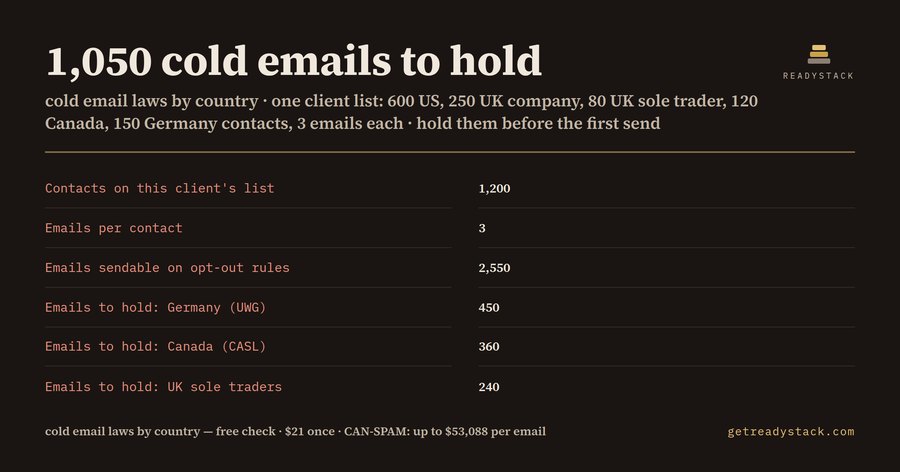
A freelance outreach writer with one client list of 1,200 prospects across the US, the UK, Canada and Germany has 1,050 cold emails to hold before a 3-step sequence goes out. Only 2,550 of the 3,600 planned emails can be sent on opt-out rules.
| One client list, 3 emails per contact | Contacts | Emails |
|---|---|---|
| US business contacts (CAN-SPAM, opt-out) | 600 | 1,800 |
| UK companies and LLPs (PECR, opt-out) | 250 | 750 |
| UK sole traders and partnerships (consent first) | 80 | 240 |
| Canada, no consent record (CASL, consent first) | 120 | 360 |
| Germany, no prior express consent (UWG, consent first) | 150 | 450 |
| Sendable on opt-out rules | 850 | 2,550 |
| Hold until consent | 350 | 1,050 |
That is 29.17% of the list. The usual answer to 'is B2B cold email legal?' is yes, if you add an unsubscribe link. Apply that answer to the whole list and all 3,600 emails go out. Apply each country's own rule and 1,050 of them should not.
The mix-up happens when one writer works for several clients. A US client's template, footer and list rules get copied to a client that sells into Germany or Canada, and nothing in the sending tool stops it.
United States: CAN-SPAM needs no prior consent. The FTC's compliance guide requires an accurate header and subject line, a valid physical postal address and a clear opt-out that you honor within 10 business days. Each separate email in violation is subject to penalties of up to $53,088, the 2025 amount the FTC kept for 2026.
United Kingdom: the ICO's business-to-business guidance under PECR lets you email corporate subscribers (companies, LLPs, Scottish partnerships) without consent, as long as you identify yourself and give an address for opt-outs. Sole traders and some partnerships count as individual subscribers and need consent or the soft opt-in.
Canada: CASL needs express or implied consent before a commercial electronic message. Implied consent covers a conspicuously published business address with no notice refusing email, if the message fits the person's role. The CRTC puts the maximum penalty at $10 million per violation for a business and $1 million for an individual.
Germany: § 7 Abs. 2 Nr. 2 UWG says advertising by electronic mail without the addressee's prior express consent is always an unreasonable nuisance, and it does not exempt B2B. A published address is not consent. The only exception, § 7 Abs. 3, covers existing customers and similar products. Competitors and associations enforce it with injunction demands.
The calculator turns those rules into counts for one client. Type the contacts by country and type, and the sequence length. It returns 12 results: contacts and emails sendable on opt-out rules, contacts and emails to hold, the share of the list, emails to hold for each consent country, the CAN-SPAM maximum if the US footer is missing an element, and the CASL maximum.
Change the client and the answer changes. A US agency client with 900 US and 40 UK company contacts on a 4-step sequence has 3,760 emails sendable and 0 to hold. A German machine builder with 700 German prospects, 120 US, 60 UK company, 10 UK sole trader and 30 Canadian contacts on 3 steps has 2,220 emails to hold, 80.43% of the list.
The free calculator runs one client list in your browser with no limit. The paid spreadsheet adds a 25-row client roster that splits each client's list by country and ranks clients by emails to hold, plus a country rules sheet with the consent rule, required content, opt-out deadline, maximum penalty and source for each of the 5 contact types.
15 seconds — what it actually does
Questions people ask
What does the cold email laws by country calculator work out?
You type one client's prospect counts by country and contact type and the number of emails in the sequence. It splits the list into contacts you may email on opt-out rules (US under CAN-SPAM, UK companies under PECR) and contacts that need consent first (Canada under CASL, Germany under § 7 UWG, UK sole traders), then counts the emails to hold.
Who is it for?
Freelance outreach writers, SDR agencies and lead-gen consultants who write cold sequences for several clients at once. When one client sells into the US and another into Germany or Canada, the same template is legal for one list and unlawful for the other. The calculator keeps each client's split on one screen before anything is sent.
Why not just ask a chatbot whether B2B cold email is allowed?
Most free answers say B2B cold email is fine as long as you include an opt-out. That holds for US contacts and UK companies. It is wrong for Germany, where § 7 Abs. 2 Nr. 2 UWG requires prior express consent even B2B, for Canada, where CASL needs express or implied consent, and for UK sole traders under PECR.
What is free and what is paid?
The web calculator is free with no limit: all 12 results for one client list, run in your browser, nothing uploaded. The paid file is $21 once, not a subscription: the same formulas in an .xlsx, a 25-client roster that ranks every client by emails to hold, and a country rules sheet with each rule and its source.
What does getting it wrong cost?
The FTC says each US email in violation of CAN-SPAM can cost up to $53,088, the 2025 amount kept for 2026. The CRTC puts the CASL maximum at $10 million per violation for a business. In Germany a competitor or association can send a formal warning under the UWG. The calculator shows these as statutory maximums, not predicted fines.
When does the US penalty figure change next?
The FTC must publish its annual civil penalty inflation adjustment by January 15 each year under the Federal Civil Penalties Inflation Adjustment Act Improvements Act of 2015. The next one is due by January 15, 2027. For 2026 it kept the 2025 amount of $53,088 per email. The calculator's penalty field will be updated when the new figure is published.
Ask about this tool
One question, answered by the person who built it. Your email only if you want the answer sent.