· ReadyStack
Worked example
Real numbers from this tool, line by line.
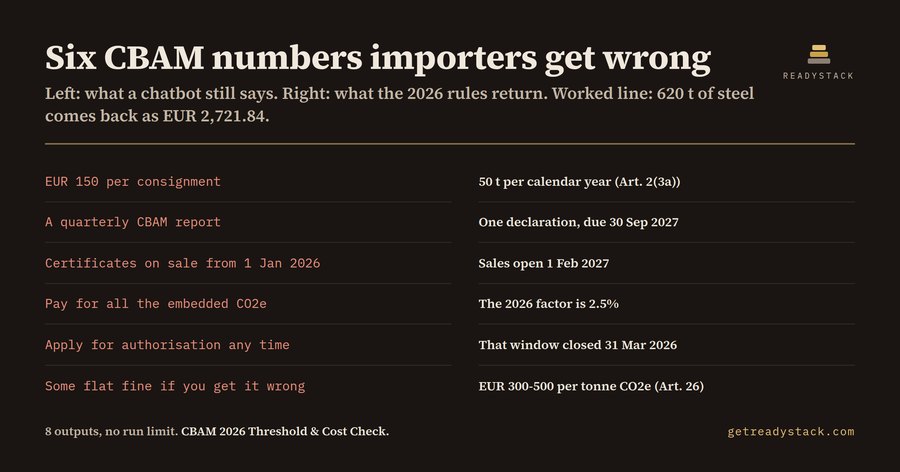
A Rotterdam customs broker's 620 t steel line for 2026 comes back as 33 CBAM certificates and EUR 2,721.84 - not the EUR 107,388.96 the same line would cost if you priced every tonne of its embedded carbon. The gap is the 2026 CBAM factor, and it is the first of six numbers that changed under the November 2025 Omnibus amendment.
The rules a chatbot still gives you
Ask a free assistant what CBAM costs an importer today and the answer is usually the transitional regime: a EUR 150 per consignment threshold, a quarterly report, certificates on sale from 1 January 2026. All three were true until the amendment landed. None of them is true now.
What replaced them: a single mass-based de minimis of 50 tonnes per calendar year (Article 2(3a), Regulation (EU) 2025/2083), one annual declaration due 30 September 2027 for 2026 imports, and certificate sales that open on 1 February 2027. The Commission's own estimate is that the 50 t line takes about 90% of importers out of the obligation while still covering about 99% of the embedded emissions. Hydrogen and electricity get no de minimis at all.
The two numbers that decide the money
The first is the CBAM factor. Free allocation in the covered sectors is phased out gradually, so in 2026 an importer surrenders certificates for 2.5% of the embedded emissions, and in 2027 for 5%. On the 620 t steel line above, at 2.1 t CO2e per tonne of goods, embedded emissions are 1,302 t CO2e. At the 2026 factor that is 32.55 t CO2e chargeable, which rounds up to 33 certificates. At the EUA benchmark of EUR 82.48 per tonne - the price a CBAM certificate tracks - the bill is EUR 2,721.84.
The second is Article 26. An authorised declarant who fails to surrender certificates pays EUR 100 per tonne CO2e. A person who brings CBAM goods into free circulation without authorised declarant status pays three to five times that: EUR 300 to EUR 500 per tonne CO2e. On the same 620 t line, the low end of that range is EUR 390,600. The application window for authorisation closed on 31 March 2026; anyone who applied before that date may keep importing while the decision is pending.
Where the threshold actually bites
The 50 t line is annual and cumulative, not per shipment, which is what makes it hard to hold in your head. A 40 t aluminium purchase at 8.6 t CO2e per tonne returns zero certificates, zero cost and 10 t of headroom - and the moment a second order crosses the line, the whole calendar year is in scope. A 2,400 t fertiliser line imported in 2027, at 2.2 t CO2e per tonne and the 5% factor, comes back as 264 certificates and EUR 21,774.72. Same tool, same inputs, three answers that are nothing alike.
What the extension does
It is a browser popup and a free web page sharing one calculation. You pick the goods group, type the net mass for the calendar year, the embedded emissions per tonne from your supplier or the Commission default, your EUA price and any carbon price already paid in the country of origin, and choose the import year. Seven inputs, eight outputs: the de minimis verdict, headroom against the 50 t line, embedded CO2e, chargeable CO2e after the factor, certificates due, cost, Article 26 exposure, and the deadline that applies to your case.
Every calculation is free, with no key, no watermark and no run limit. The 60 dollar key adds the two things a calculation cannot hand you: CSV export of the lines you ran, to file behind the declaration, and browser alarms for 1 February 2027 and 30 September 2027. It never withholds an answer.
Questions people ask
What does this extension actually do?
It runs one import line through the 2026 CBAM rules. You give it the goods group, the net mass imported this calendar year, the embedded emissions per tonne and your EUA price. It returns whether you are over the 50 t de minimis, the chargeable CO2e after the 2026 factor of 2.5%, the certificates due, the cost, and the next deadline.
Who is it for?
EU importers and customs brokers moving iron and steel, aluminium, cement, fertilisers, hydrogen or electricity into free circulation. It is built for the person who has to answer whether a shipment crosses the 50 t line this year, and what the certificates for it will cost when sales open on 1 February 2027.
Why will a chatbot not do this?
Most models still answer with the transitional rules that ended in December 2025: a 150 EUR per consignment threshold, quarterly reports and certificate sales from 1 January 2026. The November 2025 Omnibus amendment replaced all three. This extension is built on the 6 numbers that took their place: 50 t a year, a factor of 2.5%, 1 Feb 2027, 30 Sep 2027, 31 Mar 2026, and 300-500 EUR per tonne.
What is free and what needs the key?
Every calculation is free forever, with no watermark, no run limit and no key: all 8 outputs, in the popup and on the web page. The 60 dollar key adds CSV export of the lines you ran and browser alarms for 1 February 2027 and 30 September 2027. It never blocks an answer.
What would this cost if a person did it?
No CBAM consultancy publishes a day rate, so the honest comparison is the published penalty. Certificates not surrendered cost 100 EUR per tonne CO2e, and CBAM goods imported without authorised declarant status cost 300 to 500 EUR per tonne CO2e under Article 26. One certificate itself is 82.48 EUR.
Ask about this tool
One question, answered by the person who built it. Your email only if you want the answer sent.