· ReadyStack
Worked example
Real numbers from this tool, line by line.
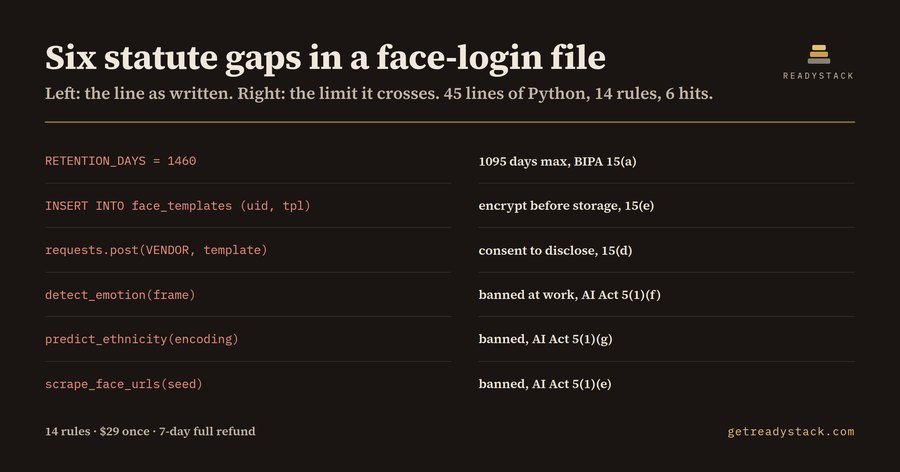
Six statute gaps sat in a 45-line Python file that a US app team had already fixed once: the consent gate was there, the written release was checked before the first capture, and the audit still returned six findings.
The file is the enrolment path of a face login: face_encodings() on a frame, keep the template, store it, send it to a matching vendor. Nothing exotic. All six findings are lines a statute reaches directly.
RETENTION_DAYS = 1460. BIPA 15(a) requires a written destruction schedule, and its outer limit is three years after the last interaction - 1095 days. The declared value is 365 days over it. Texas CUBI, Tex. Bus. & Com. Code 503.001(c-2), requires destruction within one year, 365 days. One constant, two ceilings, and the code obeys neither.
The template is written to SQLite with no encryption on the value. BIPA 15(e) requires storage using the reasonable standard of care in the industry, and at least as protectively as other confidential and sensitive information. A raw face encoding in a table column is not that.
The template is then posted to a vendor endpoint. BIPA 15(d) bars disclosure or dissemination of a biometric identifier without consent that is specific to the disclosure. The release the user signed at sign-up covered collection, not onward transfer.
The last three findings are not American. The EU AI Act's Article 5 prohibitions have applied since 2 February 2025. Art. 5(1)(f) prohibits inferring emotions from biometric data at work or in education - the file's detect_emotion() call sits in an applicant-scoring function. Art. 5(1)(g) prohibits biometric categorisation inferring race, political opinions, religion or sexual orientation; predict_ethnicity() is that. Art. 5(1)(e) prohibits building face databases by untargeted scraping, which scrape_face_urls() does. These are prohibitions, not risk tiers.
None of this is a style question, so a formatter has no opinion on it: it has no concept of a written release and cannot tell a hashed template from a raw one. A chatbot will summarise BIPA fluently without reading your file, without line numbers, and drifts on which subsection and which effective date apply. The dates are the part that moves: Colorado's HB24-1130 duties took effect 1 July 2025, the EU prohibitions on 2 February 2025.
What the numbers are worth: BIPA sets liquidated damages of $1,000 for each negligent violation and $5,000 for each intentional or reckless one, plus attorney's fees, and Illinois courts read a violation per person. Texas CUBI is enforced by the Attorney General at up to $25,000 per violation. EU AI Act penalties for a prohibited practice reach EUR 35 million or 7% of worldwide annual turnover.
The audit is 14 rules, offline, on the file. Two are arithmetic rather than pattern matching: the retention rule reports how many days a constant is over each ceiling, and the destruction-window rule compares a hardcoded enrolment date with the audit date. The same file, audited as of 22 September 2026, returns six findings; as of 1 June 2027 it returns seven, because the enrolment date in the file has by then passed the three-year window.
On the fixed version of the same service the audit returns zero findings: retention at 365 days, the template encrypted before the insert, the vendor call removed, the prohibited calls gone. One file, six lines, each with its subsection, in the editor, before the review.
A pre-launch review of biometric code by US privacy counsel bills at roughly $400 to $600 an hour.
15 seconds — what it actually does
Questions people ask
What does Biometric Consent Audit actually do?
It reads a Python, JavaScript or TypeScript file that captures a face, fingerprint, iris or voiceprint and reports the lines a biometric-privacy statute reaches: no written release before capture, no destruction schedule, retention past the 1095-day BIPA cap, an unencrypted template write, a template sent to a vendor, and the three uses the EU AI Act prohibits. Fourteen rules, each printed with its subsection.
Who is it for?
Developers and technical leads shipping face or voice login, biometric time clocks, or identity verification for users in Illinois, Texas, Colorado or the EU. It is built for the person who has to answer a security questionnaire or a demand letter about biometric handling, and who needs the answer stated in line numbers and subsections.
Why will a linter or a chatbot not do this?
ESLint and Ruff score style; they have no concept of a written release or a destruction schedule. A chatbot will summarise BIPA but does not read your file, keeps no line numbers, and is confidently wrong about which subsection applies and which dates are in force. This audit runs on your actual file, offline, and cites the subsection per line.
What is free and what needs the key?
Free, with no key: audit the file you have open and see every finding, line number and statute subsection. That is a complete job for one file. The full version adds a different axis: it scans the whole workspace at once and exports a dated evidence report, Markdown and CSV, grouped per file and per statute subsection.
What does the alternative cost?
A pre-launch review of biometric code by US privacy counsel bills at roughly $400 to $600 an hour, and the exposure it prices is statutory: BIPA sets $1,000 per negligent violation and $5,000 per intentional or reckless one, plus fees. The full version is $29 once,.
Why not just ask ChatGPT or another AI chat?
A general AI chat answers from training data with a cutoff date, cannot read your repository and names no rule version. Biometric Consent Audit (BIPA / CUBI / CO) checks the file you open against 14 rules, each naming its legal or official basis, from a rule set dated 2026-09-22, and points at the exact line. For a filing, an audit or a client you need that dated result on your own files.
Ask about this tool
One question, answered by the person who built it. Your email only if you want the answer sent.