· ReadyStack
Worked example
Real numbers from this tool, line by line.
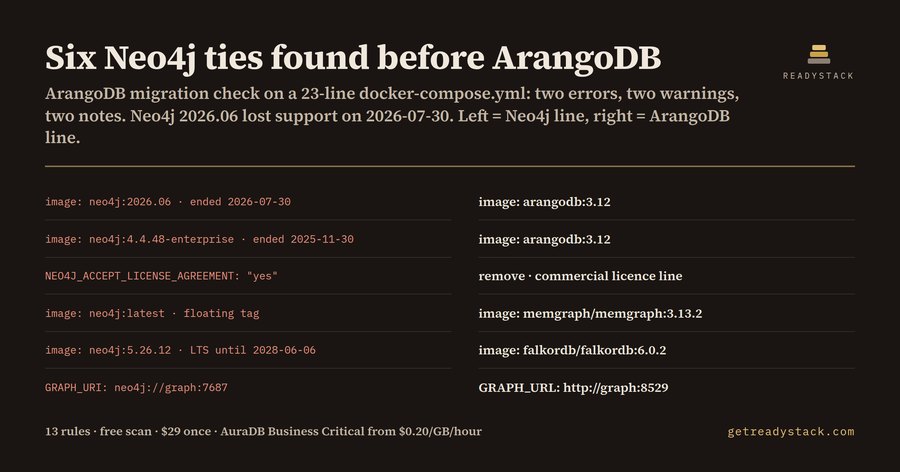
Six Neo4j ties found before ArangoDB: that is what a platform engineer in the United States or Europe gets back from one 23-line docker-compose.yml checked on 2026-10-11. Two images are past end of life, one line accepts the Neo4j commercial licence, one tag floats, one image sits on the 5.26 LTS line and one service connects over Bolt.
| Line in the file | Status on 2026-10-11 | Replacement line |
|---|---|---|
| image: neo4j:2026.06 | error: ended 2026-07-30 | image: arangodb:3.12 |
| image: neo4j:4.4.48-enterprise | error: ended 2025-11-30 | image: arangodb:3.12 |
| NEO4J_ACCEPT_LICENSE_AGREEMENT: "yes" | warning: Enterprise Edition, commercial licence | remove the line |
| image: neo4j:latest | warning: floating tag | image: memgraph/memgraph:3.13.2 |
| image: neo4j:5.26.12 | note: LTS until 2028-06-06 (604 days) | image: falkordb/falkordb:6.0.2 |
| GRAPH_URI: neo4j://graph:7687 | note: Bolt URI | GRAPH_URL: http://graph:8529 |
Why the dates move under you
Neo4j now ships calendar-versioned release lines, one a month. According to endoflife.date, each line loses support as soon as the next one ships: 2026.06 was released on 2026-07-08 and reached end of life on 2026-07-30; 2026.08 ended on 2026-09-21. The old 4.4 LTS line ended on 2025-11-30. On 2026-10-11 only two lines are supported: the newest monthly line, 2026.09, and 5.26 LTS, which runs until 2028-06-06.
So a compose file pinned in June to the newest release is out of support by August, and nobody's code changed. A tag of latest is no better: it jumps to a new line every month, so two machines pulling a week apart can run different Neo4j lines.
Why a chatbot or a web page is not enough
A chatbot answers from what it was trained on, and with a new Neo4j line every month, its list of supported tags is wrong within weeks. endoflife.date has the right dates but does not read your files. The gap is the join: which line of which file pulls which Neo4j line, and what that line should become.
What the check does
ArangoDB Migration Check reads docker-compose files, Dockerfiles, Helm values, package.json, requirements.txt, pyproject.toml, pom.xml, build.gradle, go.mod, .csproj and .env files. It has 13 rules: end-of-life images, 5.26 LTS images (a warning 365 days before 2028-06-06, an error after), floating tags, the current monthly line, the Enterprise licence line, APOC plugin lists, Bolt URIs, five driver families and the Neo4j Helm repository.
Each finding names the line and gives the replacement. ArangoDB serves HTTP on port 8529 and needs its own drivers: arangojs, python-arango, arangodb-java-driver, go-driver and ArangoDBNetStandard. Memgraph speaks Bolt on port 7687, so moving there keeps your Neo4j drivers and only changes the host. APOC calls need a rewrite on ArangoDB, which runs AQL rather than Cypher.
Try it on your own file
The free scan works on the open file in VS Code, or in the browser on the web version, with no key. Change the as-of date to see what turns red later: the same compose file checked on 2027-06-10 turns the 5.26 image into a warning, because 2028-06-06 is then under a year away.
With a licence key you get the whole workspace in one migration plan, a dated end-of-life report for the company and a CI gate that fails a build adding new Neo4j use. For comparison, staying on managed Neo4j costs from $0.20/GB/hour on AuraDB Business Critical and from $0.09/GB/hour on AuraDB Professional, per Neo4j's pricing page on 2026-10-11.
15 seconds — what it actually does
Questions people ask
What does ArangoDB Migration Check do?
It reads a docker-compose.yml, Dockerfile, Helm values, package.json, requirements.txt, pom.xml, go.mod, .csproj or .env file and names every Neo4j tie with its line: images, Enterprise licence lines, Bolt URIs, APOC plugins and drivers. Each image is dated against endoflife.date (Neo4j 2026.06 ended 2026-07-30, 4.4 ended 2025-11-30) and paired with the ArangoDB, Memgraph or FalkorDB line that replaces it.
Who is ArangoDB Migration Check for?
Platform engineers, backend developers and DevOps teams who run Neo4j in Docker or Kubernetes and are moving to ArangoDB, Memgraph or FalkorDB, or who need to know which of their Neo4j images are already past end of life. It also suits a tech lead who must tell the company how many projects still pull Neo4j and since when.
Why not just ask a chatbot or read endoflife.date?
Neo4j ships a new release line every month and each one loses support when the next ships, so a chatbot's answer about which tag is still supported is often months stale. endoflife.date lists the dates but does not read your files. This tool reads each image tag, licence line, URI and driver in your file and dates it on the day you run it.
What is free and what needs a licence key?
Free: scan the open file and get every Neo4j tie with its line, its end-of-life date and the replacement line, with no key and no limit. With a key: the whole workspace in one migration plan with each item mapped to its replacement, a dated end-of-life exposure report for the company, and a CI gate that fails builds adding new Neo4j use.
What does staying on managed Neo4j cost?
Neo4j's own pricing page lists AuraDB Professional from $0.09 per GB per hour (minimum 1 GB instance) and AuraDB Business Critical from $0.20 per GB per hour (minimum 2 GB instance), checked on 2026-10-11. Self-managed Enterprise Edition is sold by quote. The check is $29 once, one key per person or team seat.
When does the next Neo4j support date change?
The 5.26 LTS line reaches end of life on 2028-06-06 according to endoflife.date. The tool turns 5.26 images into warnings 365 days before that date and into errors after it. The monthly lines change sooner: each one loses support as soon as the next monthly release ships, as 2026.08 did on 2026-09-21.
Ask about this tool
One question, answered by the person who built it. Your email only if you want the answer sent.