Claude Code skills · updated 2026-10-03
Manuscript disclosure skill for Claude Code — AI use, funding, data statements
14 disclosure findings in one LaTeX manuscript, each with file:line and the fix
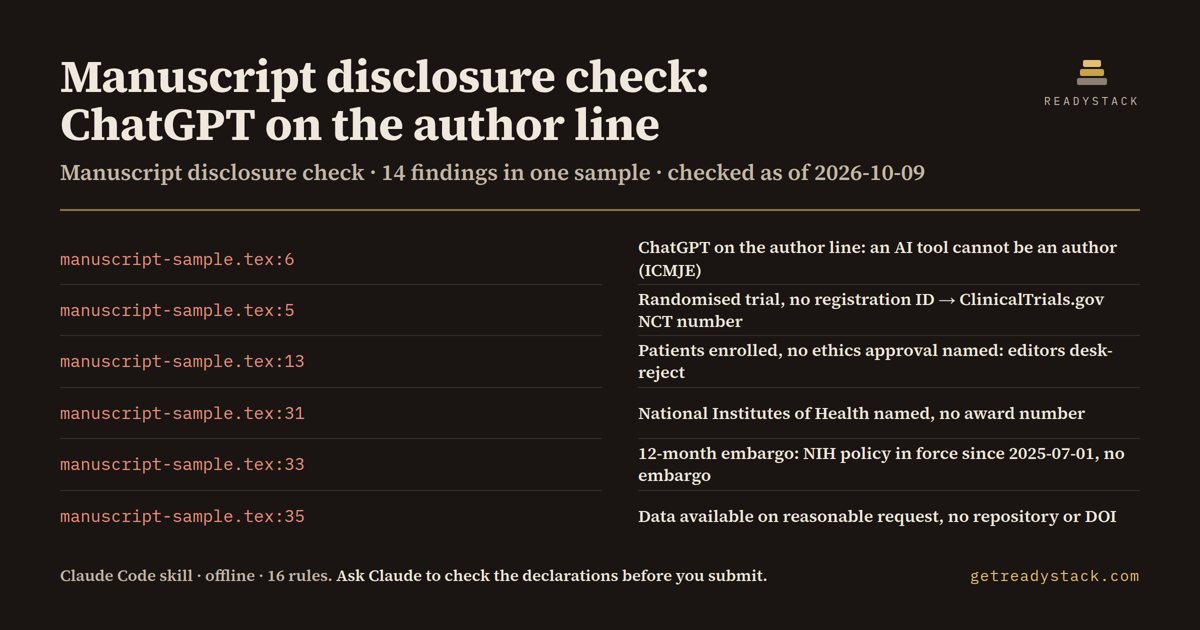
On the bundled sample: 14 findings (9 errors, 5 warnings) in 1 file from 16 rules, including ChatGPT on the author line, an unregistered randomised trial and a 12-month NIH embargo.
Get it on Whop - $12 onceGet it on Gumroad
Who it's for
For researchers and lab teams who write papers in LaTeX or Markdown and submit to ICMJE journals or under NIH, UKRI or Horizon Europe funding.
What breaks, and when
Editors desk-reject a paper with no ethics approval before it reaches a reviewer, and the 2024 NIH Public Access Policy, in force since 2025-07-01, allows no 12-month embargo.
What it printed on the bundled example
== Manuscript Lint — 14 findings (9 errors, 5 warnings) in 1 file · 16 rules
  ERROR manuscript-sample.tex:1  [ai_disclosure_missing]
        No AI-use disclosure. Journals following the ICMJE Recommendations ask authors to state whether generative AI was used in writing, and to name the tool and the task. → add a short 'Declaration of generative AI in the writing process' section, even to say none was used
  ERROR manuscript-sample.tex:1  [funding_statement_missing]
        No labelled funding statement. Publishers index funding separately from the acknowledgements, and a funder that cannot find its award in the record counts the paper as unreported. → add a 'Funding' section, or state that the work received no specific funding
  ERROR manuscript-sample.tex:1  [competing_interests_missing]
        No competing interests statement. The ICMJE disclosure is required from every author, and 'none' has to be written down rather than left out. → add 'Competing interests: the authors declare none.' if that is the case
  WARN  manuscript-sample.tex:1  [author_contributions_missing]
        No author contributions statement. CRediT (ANSI/NISO Z39.104-2022) is now collected at submission by most large publishers. → add an 'Author contributions' section using the 14 CRediT roles
What you get
- SKILL.md, an offline Node scanner (scripts/scan.js) and the 16-rule table
- file:line, severity and why each missing statement matters
- The sentence to add, drafted only from facts you supply
- CI: node scripts/scan.js . exits 1 on any error
Install
Unzip into ~/.claude/skills/ (all projects) or your-repo/.claude/skills/ (one repo), then ask Claude Code: "Is this paper ready to submit to the journal? Check the disclosure statements. Don't edit anything yet.". Needs Node 16+.
unzip manuscript-disclosure-check.zip -d ~/.claude/skills/
Ask Claude
“Is this paper ready to submit to the journal? Check the disclosure statements. Don't edit anything yet.”
What it does not do
It does not know one journal's own guidelines or verify a DOI or grant number; no network calls, no edits without your OK.
FAQ
What is a Claude Code skill?
A folder with a SKILL.md and scripts that Claude Code loads when your request matches it. You ask in plain words and Claude runs the scanner the skill carries.
How is this different from asking Claude without the skill?
The skill carries a dated rule table and a scanner that reads every file, so Claude quotes the exact date and line instead of answering from memory.
Does it send my code anywhere?
It does not know one journal's own guidelines or verify a DOI or grant number; no network calls, no edits without your OK.
How do I install it?
Unzip into ~/.claude/skills/ (all projects) or your-repo/.claude/skills/ (one repo), then ask Claude Code: "Is this paper ready to submit to the journal? Check the disclosure statements. Don't edit anything yet.". Needs Node 16+.
What do I get when I buy?
The zip. On Whop it is in your library as a download lesson with the zip attached; on Gumroad it is the product file.